
It seems like a long time ago now.
We wore masks in lift lines, tried to remember whether a neck gaiter satisfied ever-changing rules, and sized up strangers with a skeptical eye before deciding who we would share a chairlift ride with.
For Mid-Atlantic ski areas, the timing of COVID’s arrival offered one small consolation: the season was already nearing its end. The shutdown still cost resorts remaining ski days and disrupted spring trips, but most of the winter’s business was behind them.
On March 14, 2020, Vail Resorts announced that it would suspend operations at all of its North American properties, including Pennsylvania’s Liberty, Roundtop, Whitetail, Jack Frost, and Big Boulder. Three days later, the company said those resorts would remain closed for the season. Other ski areas made similar decisions as public-health restrictions spread and guests began canceling trips.
Building a Ski Season Around a Virus
By the summer of 2020, ski resorts were already busy trying to determine whether they could safely open in the Fall, and if so, whether any guests would feel comfortable enough to actually show up.
Resorts also had to persuade skiers to buy passes for a winter nobody could confidently predict. In April 2020, Vail Resorts introduced free Epic Coverage for the coming season, offering refunds for qualifying resort closures, including those caused by COVID, and certain personal circumstances such as illness or job loss.
The company also offered existing passholders credits toward renewal after the shortened 2019–2020 season and extended purchase deadlines. For families weighing another winter at Liberty, Roundtop, or Whitetail, those protections provided some reassurance that committing early would not mean losing their entire investment if the pandemic again shut down skiing.
Skiing had an obvious advantage over theaters, restaurants, and many other forms of recreation: most of it happens outside. But ski areas also operate rental shops, cafeterias, restrooms, shuttles, hotels, and crowded base lodges. Chairlifts regularly seat strangers shoulder to shoulder. A busy Saturday at Whitetail or Seven Springs can place thousands of people in the same base area, even if they eventually spread out across the mountain.
The National Ski Areas Association developed a “Ski Well, Be Well” operating guide calling for face coverings, physical distancing, employee health checks, enhanced cleaning, touchless transactions, and special plans for indoor spaces and lift queues. Individual resorts then adapted those ideas to state rules, mountain layouts, and the technology they had available.
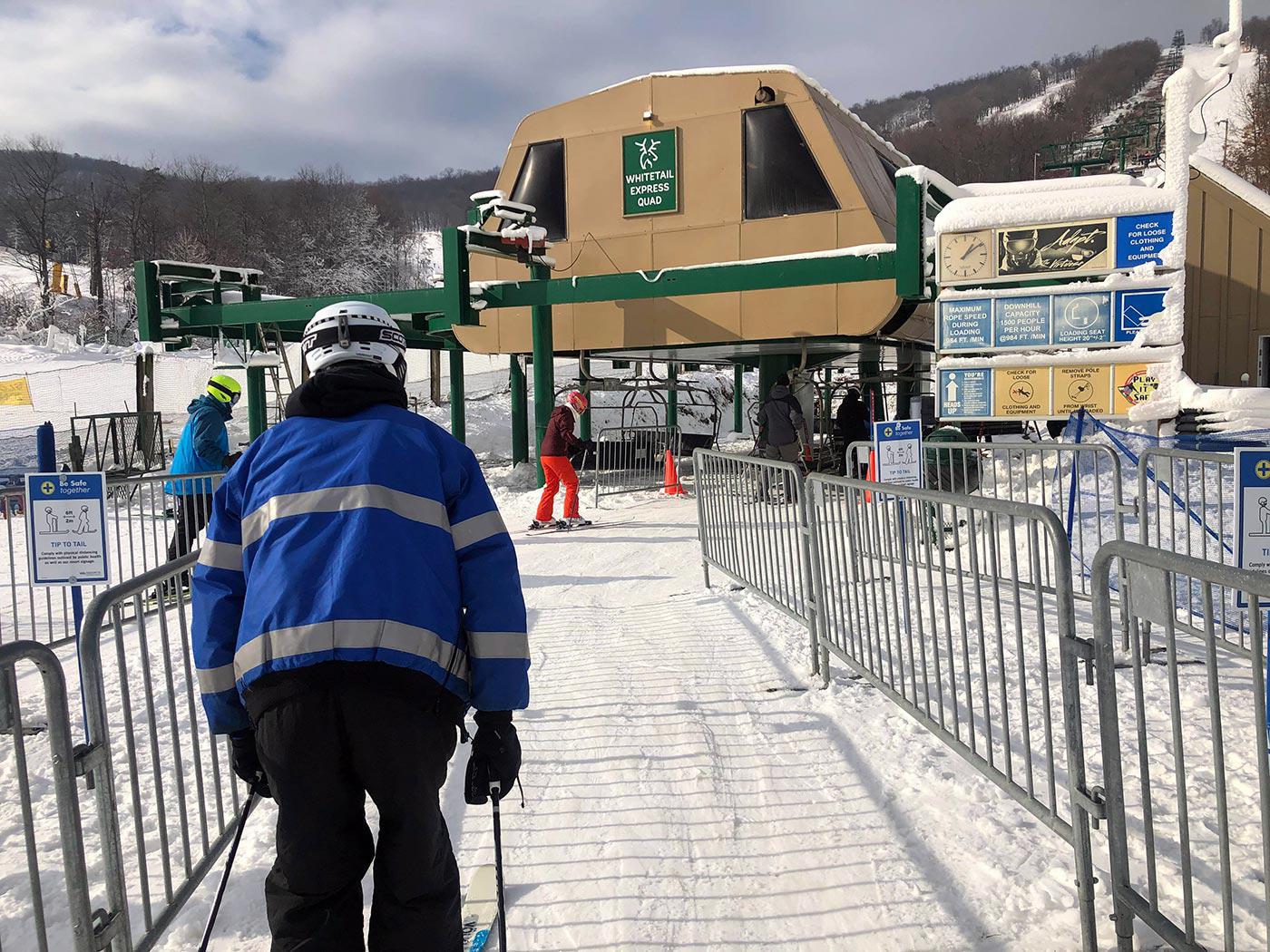
Vail Resorts, which operates many ski areas in Pennsylvania and across the country, introduced one of the most extensive systems. As DCSki reported in August 2020, every skier at the company’s resorts needed a reservation for the upcoming winter, with passholders receiving priority. Daily tickets were tied to specific dates and sold online or through call centers; walk-up ticket-window sales were eliminated. Masks were required in lift lines and on lifts, unrelated groups were separated, restaurant seating was reduced, and many food transactions became cashless.
The rules were complicated enough that DCSki conducted an interview with Vail Resorts official Jamie Storrs to address questions from local skiers. Could someone with an Epic Pass reserve a random weekday at Whitetail? What happened if plans changed? How would limited early-season terrain affect capacity? Would night tickets still be available? These were practical questions from people trying to figure out whether an ordinary ski day would still be possible.
West Virginia’s Snowshoe Mountain Resort took a somewhat different approach. Season passholders did not initially need mountain reservations, but daily capacity was limited and walk-up access was not guaranteed. The West Virginia resort encouraged advance purchases of tickets and rentals, expanded outdoor dining, limited lesson sizes, and assigned hosts to monitor lodge capacity.
Across the region, policies differed in the details, which made checking a resort’s web site nearly as important as checking its snow report.
There was also the small matter of enforcing all of this. Lift attendants and other front-line employees found themselves policing masks and spacing in addition to loading chairs and helping guests. In a December 2020 opening-season report, DCSki noted that most visitors appeared to be following the rules, although some resorts said employees were taking abuse from guests who did not want to comply.
A Strange, Yet Successful, Season
For all the uncertainty, the 2020-2021 season did not become the industry disaster many feared. Americans were eager to get outside, and skiing offered fresh air, exercise, and a few hours in which the largest immediate concern could once again be an icy patch or a fogged pair of goggles.
The National Ski Areas Association counted 59 million skier visits nationwide, the fifth-highest total recorded at the time. Small and medium-sized areas performed particularly well as travelers stayed closer to home. That favored the Mid-Atlantic, where millions of people can reach a ski area without boarding an airplane. A day at Bryce, Massanutten, Liberty, or Roundtop looked considerably more manageable than a cross-country trip involving airports, rental cars, and unfamiliar local restrictions.
Remote work and school also changed the weekly rhythm. Nationally, weekday visits rose sharply, accounting for 48 percent of all visits during the pandemic season. Some skiers could answer e-mail in the morning and make afternoon turns; families whose schedules had become untethered from the classroom found new opportunities to visit outside the traditional weekend crush.
But while skier days increased, other aspects of the business suffered. Group lessons fell sharply. Restaurants operated with limited seating or relied on takeout, reducing an important source of resort income (and profit). The cancellation of events, restrictions on indoor gatherings, and fewer lessons affected both revenue and the social side of skiing.
Staffing was another major problem: 60 percent of ski areas responding to the national survey said they were not fully staffed, with restrictions on international worker programs contributing to the shortfall.
Guests improvised too. DCSki reader Michael Dewhirst described Whitetail’s December 2020 opening as surprisingly streamlined, with one obvious exception: he, and many other guests, ate lunch in the parking lot.
In the DCSki Forum, Woody Bousquet reported tailgating at Bryce with folding chairs, food, drinks, and a welcome mat after riding to the resort with a friend while masked and with the car windows cracked open. The cold shoulder he experienced on the drive was quite literal.
The parking lot became an extension of the lodge. Skiers put on boots while perched on their car bumpers, packed thermoses and turkey sandwiches, and learned which vehicles made suitable windbreaks. Some families erected elaborate tailgate setups; others ate hurriedly behind a raised hatch or simply munched on a granola bar slopeside. It was less elegant than a table beside the fireplace, but it had its own charm.
Travel choices took on considerations that had little to do with snow quality. In a 2021 DCSki trip report from Sun Valley, John Sherwood explained that he selected the Idaho resort partly for its low crowds, outdoor lodge seating, and lack of gondolas. Closer to home, skiers debated whether to share a car, enter a lodge, take a lesson, or ride a chair with someone outside their household.
What Remains
Most of the visible pandemic rules disappeared fairly quickly. For the 2021-2022 season, Vail Resorts dropped mountain reservations, returned lifts to normal loading, and ended outdoor mask requirements, while retaining safeguards for indoor spaces. Those indoor rules eventually faded as well.
Today, strangers once again fill empty seats on chairlifts, cafeterias are crowded on cold Saturdays, and few people consider a trip to the lodge an epidemiological decision, although we might still instinctively bristle if someone nearby sneezes.
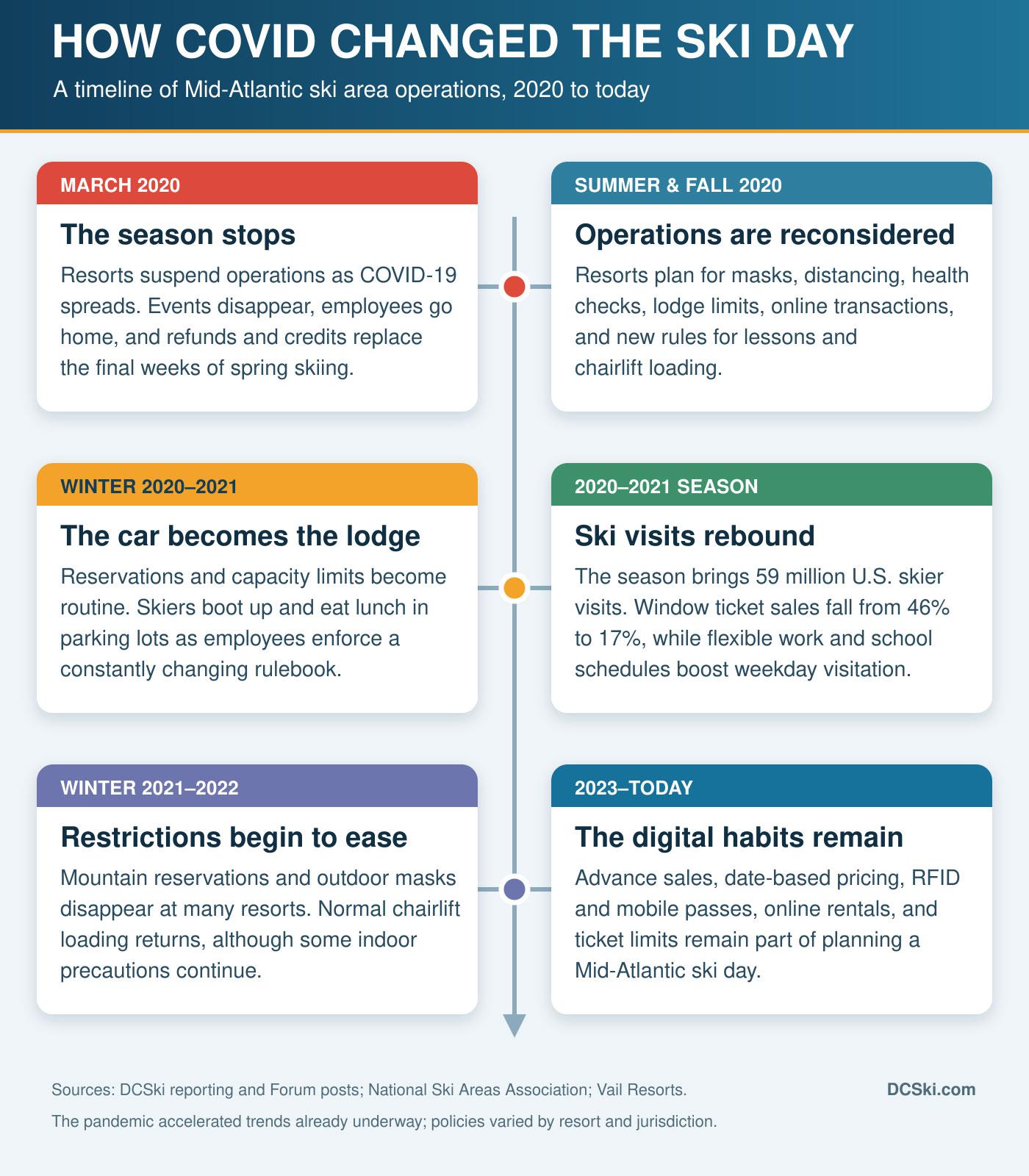
The business side of resorts did not return completely to 2019. COVID accelerated a move toward advance online purchasing that was already well underway. During the pandemic season, the share of lift tickets sold at resort windows fell nationally from 46 percent to 17 percent. Resorts discovered that online sales could reduce ticket-window lines (and necessary staffing), speed up arrival, provide useful information about expected crowds, and encourage guests to commit before seeing the morning weather.
We see this today around the Mid-Atlantic. Snowshoe currently tells customers that rates and availability can change and that buying in advance saves money. Vail-owned resorts sell date-specific tickets online and warn that sales may be limited.
Dynamic pricing, once associated mainly with airlines and hotels, is now a routine part of planning a ski day, for better or worse. Showing up at a ticket window is still possible at some areas, but it is rarely the least expensive approach and sometimes carries the risk that tickets will be gone.
Contactless technology also kept moving forward. RFID gates and reloadable cards reduce the need to visit a window, while digital waivers, online rental reservations, and mobile food ordering have become common.
In 2023, Vail Resorts went further by introducing lift access through the My Epic app, allowing a phone in a skier’s pocket to serve as a pass or lift ticket. The technology arrived after the emergency phase of COVID, but it followed the direction in which the pandemic had pushed the industry: fewer transactions at a counter and more of the ski day arranged before arrival.
Capacity management still exists, although usually only kicks in on the busiest holiday days. Local resorts don’t require season passholders to reserve ordinary ski days, but many limit the number of daily tickets sold for popular dates. That can be frustrating for a skier hoping to make a last-minute decision after fresh snow, yet it also gives operators a better chance of matching attendance to available terrain, parking, rentals, and food service. During the pandemic, capacity was a public-health tool. It has since become part of inventory and crowd management.
Other changes are harder to separate from trends that were already underway. Reduced operating hours and fewer night-skiing sessions at some Mid-Atlantic resorts followed a period of severe staffing strain, but labor costs, energy prices, weather, and corporate strategy also played roles.
A greater reliance on season passes and prepaid products likewise predates COVID, although the uncertainty of 2020 encouraged resorts to strengthen pass-protection and refund programs. A version of Vail’s Epic Coverage, introduced for the pandemic winter, remains included with eligible passes today.
Some personal habits lasted too. Plenty of skiers happily returned to the lodge, while others discovered that putting on boots at the car saves time (and locker money) and that a packed lunch costs less than resort food.
Remote work continues to make an occasional midweek ski day possible for people who once could only visit on jam-packed Saturdays.
COVID placed ski areas in an extraordinary position. They had to protect employees and mountain communities, comply with changing state and local rules, and re-design dozens of guest interactions while still delivering something that people urgently wanted: a day outside in winter.
Resorts did not handle every detail perfectly, and guests did not always make life easy for the employees asked to enforce the rules. Still, the lifts turned, the season continued, and skiing provided a welcome measure of normalcy during a decidedly abnormal year.
Six winters later, the ski day has become more digital, more dependent on advance purchases, and more carefully managed because of that season. The emergency ended, but some of the adaptations simply became the way we ski.



Reader Comments