
Woody: I grew up in Pittsfield, in the Berkshire Hills of western Massachusetts. For the past 30-plus years my wife Jenny and I have lived in Winchester, located in Virginia’s storied Shenandoah Valley. I count myself blessed to be surrounded by the Appalachians for much of my life. Those mountains have nurtured my passions as a naturalist, my livelihood as an environmental studies professor, and my recreation as a hiker and skier.
Scott: With a family name connected to skiing, I’m guessing the sport entered your life fairly early. What are your first memories of skiing, and where did you learn?
Woody: My dad Russ Bousquet and his brother, my uncle Paul, were managing Bousquet’s Ski Area when I was born. Significant snow fell that night. Six days later, after the ski area closed out its first weekend of the season, I wore my first skis. A nurse brought me in to see my mom, with two long tongue depressors bound to my feet by gauze. Mom was worried that something was wrong until the nurse explained, “Woody is wearing his skis!” So I started early.
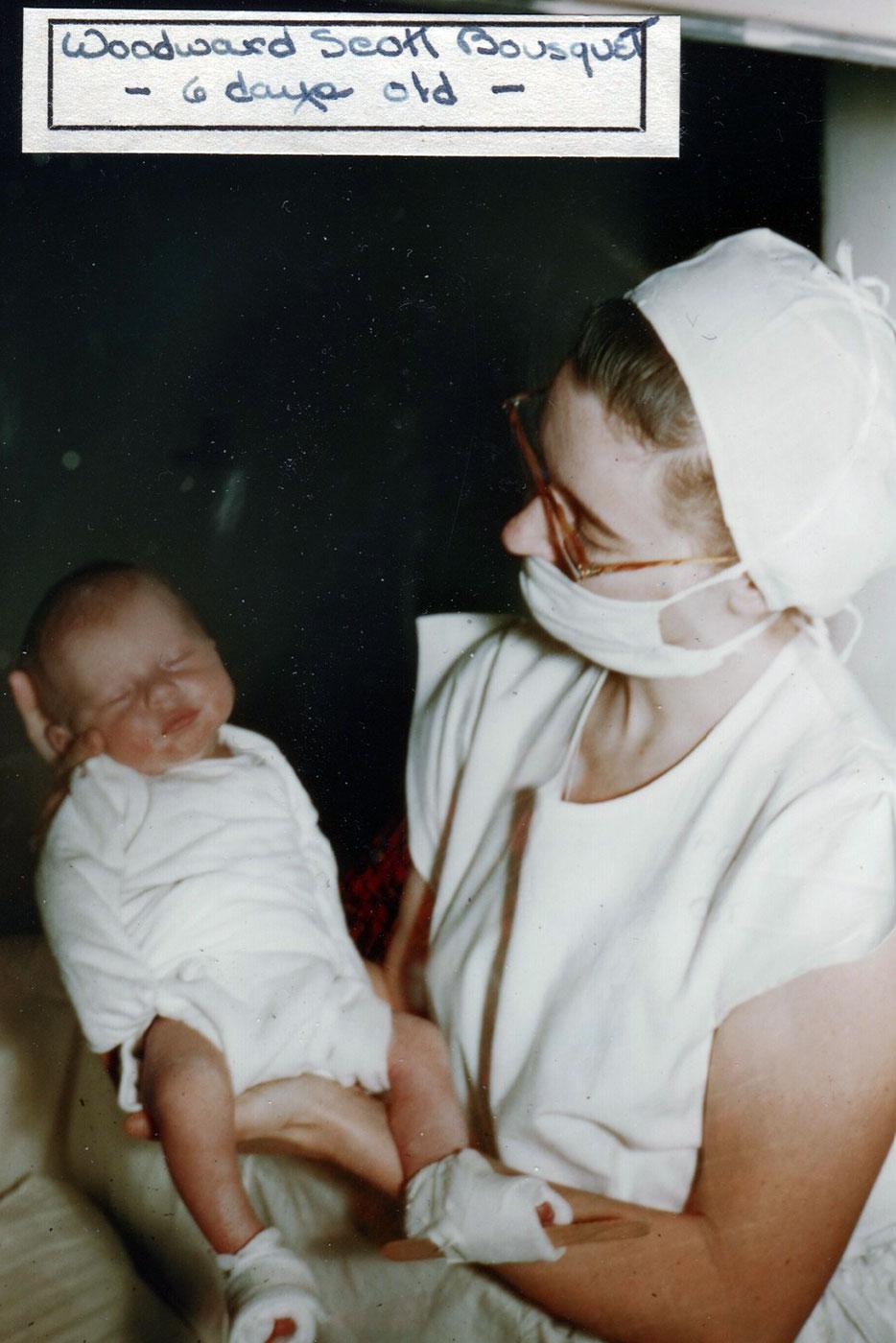
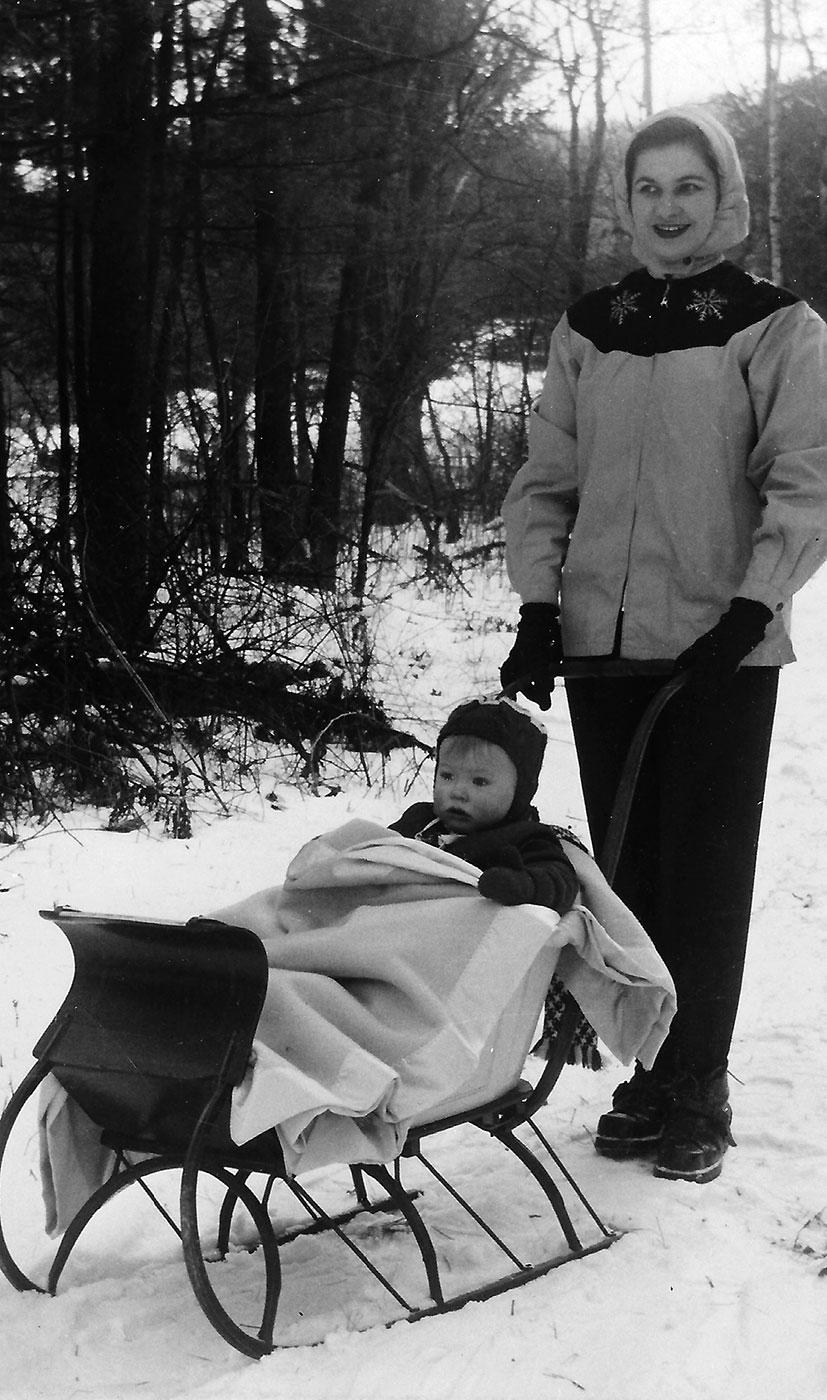
The family sold Bousquet’s in 1956, when I was two-and-a-half years old. I went down some lower runs at the ski area before I turned eight, but only when stabilized by hanging onto my dad.
Most of my early skiing involved just noodling around our Pittsfield neighborhood on those toy skis many of us kids had that were outfitted with straps that fit over your everyday boots. I didn’t get serious about wanting ski lessons until I was in fifth grade. My teacher at Bousquet’s was Jon Mahanna, who eventually had a long career in ski instruction. He was somewhat famous for a photo, “And Now for My Next Trick…” in which photographer Warren Fowler caught Jon losing a ski in midair while doing a backflip near the base of the Bousquet chairlift.
Scott: What role has skiing played throughout the rest of your life? Where have you skied most frequently, and what kinds of ski areas or terrain tend to appeal to you?
Woody: While most of my early skiing was at nearby Bousquet’s, I became an obsessive area-hopper in high school. Terrain was less important than checking out different ski areas and different kinds of ski lifts.
Riding my first J-bar at Otis Ridge in Massachusetts was as important as long day trips from Pittsfield to Vermont to ski Mad River Glen for the single chair, and then Sugarbush Valley to ride the gondola. Each new ski area meant a new ski patch for my mom Jean to sew onto my jacket. I had a dozen by the end of tenth grade.
When I went to college in the early 1970s, skiing became less convenient and more expensive, so I switched to winter hiking and backpacking. I didn’t take up skiing again until 2003 when our son Ben, and later our daughter Caitlin, gave it a try after we bought a condo at Wintergreen in Virginia. Yes, that gap in my skiing lasted more than 30 years.
Skiing, to me, has been less about perfection and more about winter exercise, outdoor fun with friends and family, enjoyable travel through snowy landscapes, and a closeness to nature during a special time of the year. Except for a year or two challenging the moguls and a few glades, I’ve never been more than an intermediate-level skier – even after technology ushered in shaped skis, expanded snowmaking, and much better grooming.
My excuses are few. As I explained to Ben, though, I don’t ski as fast as he does because I don’t bend as much, I don’t bounce as high, my bones break more easily, and my body heals more slowly than his.
After we sold our Wintergreen place, my home mountains became Whitetail and Liberty, and now Timberline. For the record all of my skiing has been in eastern North America, from Tennessee and North Carolina to Maine and Quebec. I’ve skied at a few more than 100 ski areas, which means a lot of ski patches. More about that later.
Scott: Do you remember how you originally discovered DCSki? What prompted you to begin participating in the Forums and contributing material to the Lost Ski Areas project?
Woody: A couple of years after getting back onto skis, I began looking online for information about skiing here in the Mid-Atlantic and in my old New England stomping grounds. It didn’t take me long to find DCSki and Snowjournal.
I’d never even heard of Timberline, Liberty, Bryce, or dozens of other ski areas in our region. What’s drawn me to the DCSki Forums has been the community that participates: by and large helpful, good-humored, and noncompetitive. We enjoy each other’s trip reports and photos, we post updates on snow conditions, we sympathize with injuries and health setbacks, and we mourn the passing of those who’ve become friends.
My most memorable DCSki experiences have been meeting up on the snow, which I’ve done several times, and getting gobs of detailed advice around 2010 when I decided it was time to let go of my “eBay specials” and buy my first pair of new skis in almost fifty years. (I’m still skiing on Dynastar Legends, by the way. Thanks everybody!)
Scott: You have assembled an extensive collection of ski memorabilia. How did the collection begin? Was there one purchase, inherited item, or discovery that turned a casual interest into a serious pursuit?
Woody: My interest in ski history grew from being part of a family that had founded one of this country’s oldest ski areas. The stories didn’t end when Bousquet’s was sold. Family members had plenty of tales to tell when we got together during vacations or over the holidays.
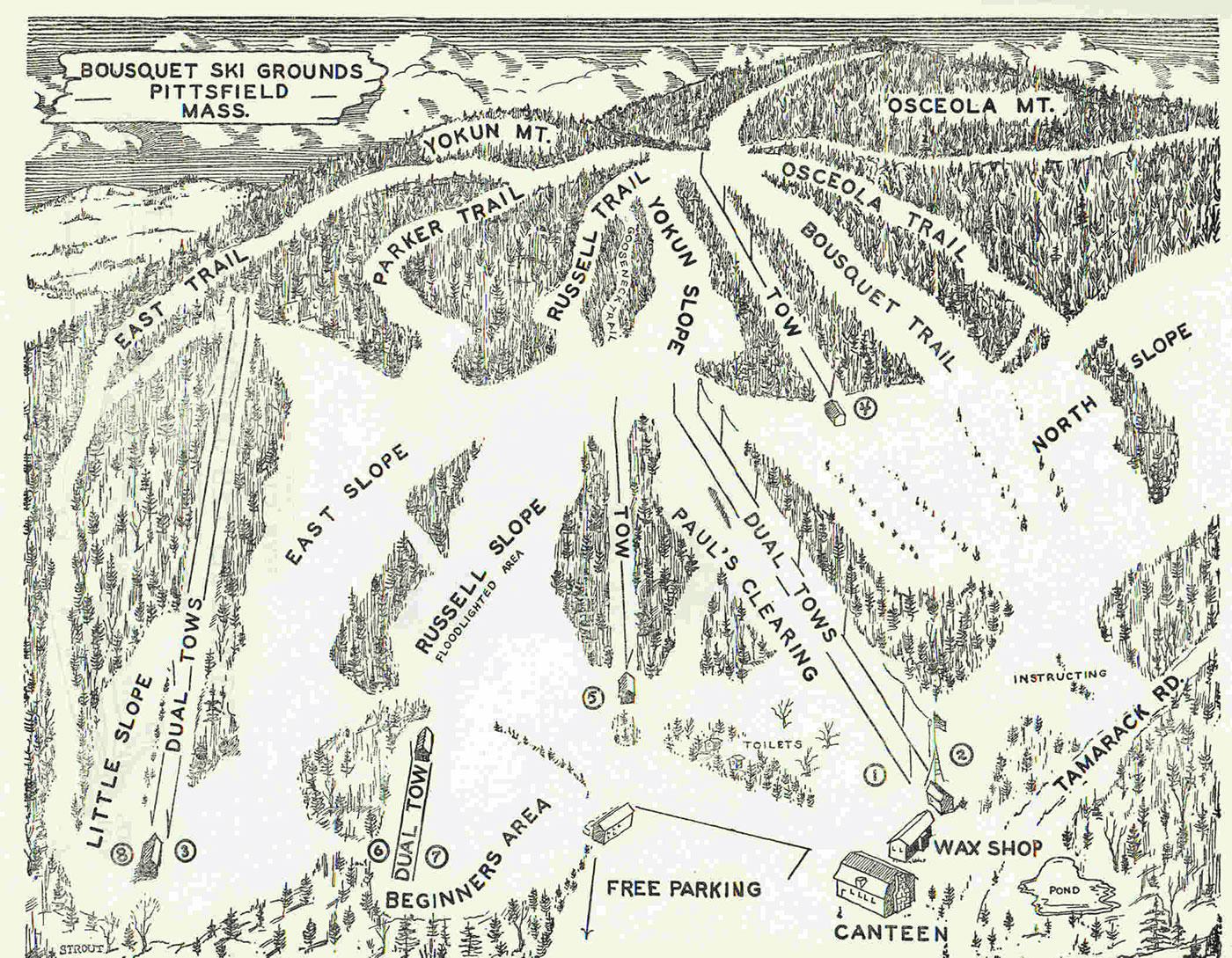
Also, in my dad’s desk was a stack of letterhead that pictured Bousquet’s Ski Tow Gripper on the front and had a c.1950 map of the Bousquet Ski Grounds on the reverse. That letterhead became my doodles, book report drafts, and dozens of paper airplanes.
I’ve already mentioned collecting ski patches as I skied different areas while growing up. Without the internet, the way I fantasized about my next ski ventures was to pick up maps from the racks of brochures at local sporting goods shops in my home town.
One time I grabbed the Eastern Ski Map published by The National Survey of Chester, Vermont. The huge map was surrounded by ads. To many of those ski areas, I started mailing letters that read, simply, “Please send me a map of your ski area,” and included my address. To a kid in sixth grade, it was so cool to get mail. (This was before email and social media, of course.) One day when I was home with chicken pox, I received 10 envelopes from ski areas. I read them, saved them in an accordion file, reread them again and again, and … like so much of the stuff you accumulate when you’re young … they went into the landfill when I packed up for college.
Fortunately, Mom carefully snipped off the ski patches from my ski jacket – patches that she’d carefully sewn on years before. I still have those. When I took up skiing again, I began to collect ski maps and ski area patches again. I sought out the old ones in particular.
Scott: What does the collection include today? Are there particular types of memorabilia – such as patches, brochures, trail maps, photographs, postcards, pins, or lift tickets – that interest you most?
Woody: As my wife explains, I was born with the collector gene. One of the reasons she accepts (she might say tolerates) my ski memorabilia more than my other collections is that it’s compact. I stayed away from the clunky things – vintage skis and trail signs – although an old skimobile car from Mt. Cranmore New Hampshire was very, very tempting when a few were offered for sale. Most of my collection today is ski patches, trail maps, brochures, pins, and some paper tickets.
Scott: Do you have any idea how many ski areas are represented in the collection? Is there a particular geographic or historical focus, or will almost any interesting piece of ski history catch your attention?
Woody: My collection definitely has some focuses. In rough order of priority, I collect ski items from the Berkshires in Massachusetts, Vermont areas, ski areas I’ve skied, and eastern North America areas (Newfoundland and Quebec, to North Carolina and Alabama, and across to Ohio). I probably have material from around 200 places.
Scott: How do you find new items? Are you regularly searching online auctions, antique stores, and estate sales, or do artifacts increasingly find their way to you through people who know about your collection?
Woody: Several family members and I enjoy scrounging around in antique stores, but I’ve found only a handful of ski brochures and patches there. My favorite way to find things is exchanging or trading with others who’ve been bitten by the ski collecting bug. Several friends have given me their old patches, pins, tickets, or brochures because they know I collect them.
But most of my items come from online sources, primarily eBay listings. When I started searching online around 20 years ago, there would be accumulations of 5, 10, or even 30 or more vintage patches being auctioned as a single lot and selling for reasonable prices. Those “mother lodes” of desirable patches at good prices rarely show up today. Sellers have learned that taking the time to list items singly provides a much better payoff. And there are more buyers around today, although the number of ski memorabilia collectors is still rather low.
Scott: What makes an item interesting or worth acquiring for you? Are you drawn primarily to rarity, visual appeal, personal connections, or the history the item can help document?
Woody: Ahh yes. Good question! I try to collect vintage (usually pre-1980) ski patches. I look for the early brochures or trail maps from a given area. An old and detailed trail map, a vintage (or even newish) ski area patch with a creative design, or a staple-on ski ticket will always catch my eye.
Scott: Is there one item — or a small group of items — that you consider the centerpiece of your collection? What makes it especially meaningful?
Woody: It’s probably not a surprise that the material from Bousquet Ski Grounds holds special places in my collection. I have the wooden marlinspike that my dad used to splice ski tow ropes. I also have the plaque that commemorates my grandfather Clarence’s posthumous induction into the US Ski and Snowboard Hall of Fame in 2003. And on our kitchen wall is a 1940s sign for Russell Trail (now Dino’s Chute), originally named after my father. The first Bousquet’s brochure (1936), early ski tow grippers, my mom’s 1945 Mt. Greylock Ski Club pin, and the first Bousquet’s ski patch (1940s) would round out the family centerpieces.
Scott: Conversely, is there an elusive piece of memorabilia that you have searched for over the years without finding?
Woody: Each year I learn about ski patches or brochures I hadn’t known about before, so I’m always on the lookout for something different, especially if it verifies or provides new information about a lost ski area.
From the Mid-Atlantic, I’d like to add to my collection brochures and patches from Braddock Heights in Maryland and Richmond Hill in Pennsylvania. Farther afield, my longstanding holy grail has been a patch from Chickley Alp Ski Center, a lost area that operated in West Hawley, Massachusetts. I have their brochure. I’d also like to find a vintage patch from Beartown, a community ski area still operating on the northern edge of New York’s Adirondacks.
For more than a decade, an Underhill (VT) Ski Bowl patch and Shawnee-Land (VA) brochure had eluded me. A collector friend found the Underhill patch and traded it to me, while a Shawnee-Land brochure eventually popped up on eBay. So sometimes my persistence and patience have paid off.
Scott: You’ve told me in the past that displaying and storing the collection has been a challenge, but that you’re pleased with how it has turned out. How have you organized and displayed everything?
Woody: I store and display all of my patches and my more interesting trail maps and brochures in acid-free plastic pages that I’ve organized by state into 2- or 3-inch binders. They sit on a bookshelf. I try to make the pages interesting to look at, like a scrapbook, by mixing patches, maps, postcards, and tickets together, sometimes on a single page.
Each time I visit a ski area, I pick up two trail maps — one to keep, and one to give away or trade. Our house doesn’t have room for all of these newer maps in binders, so, for now, I’ve sorted them by year into ziplock bags and keep them in a couple of boxes.
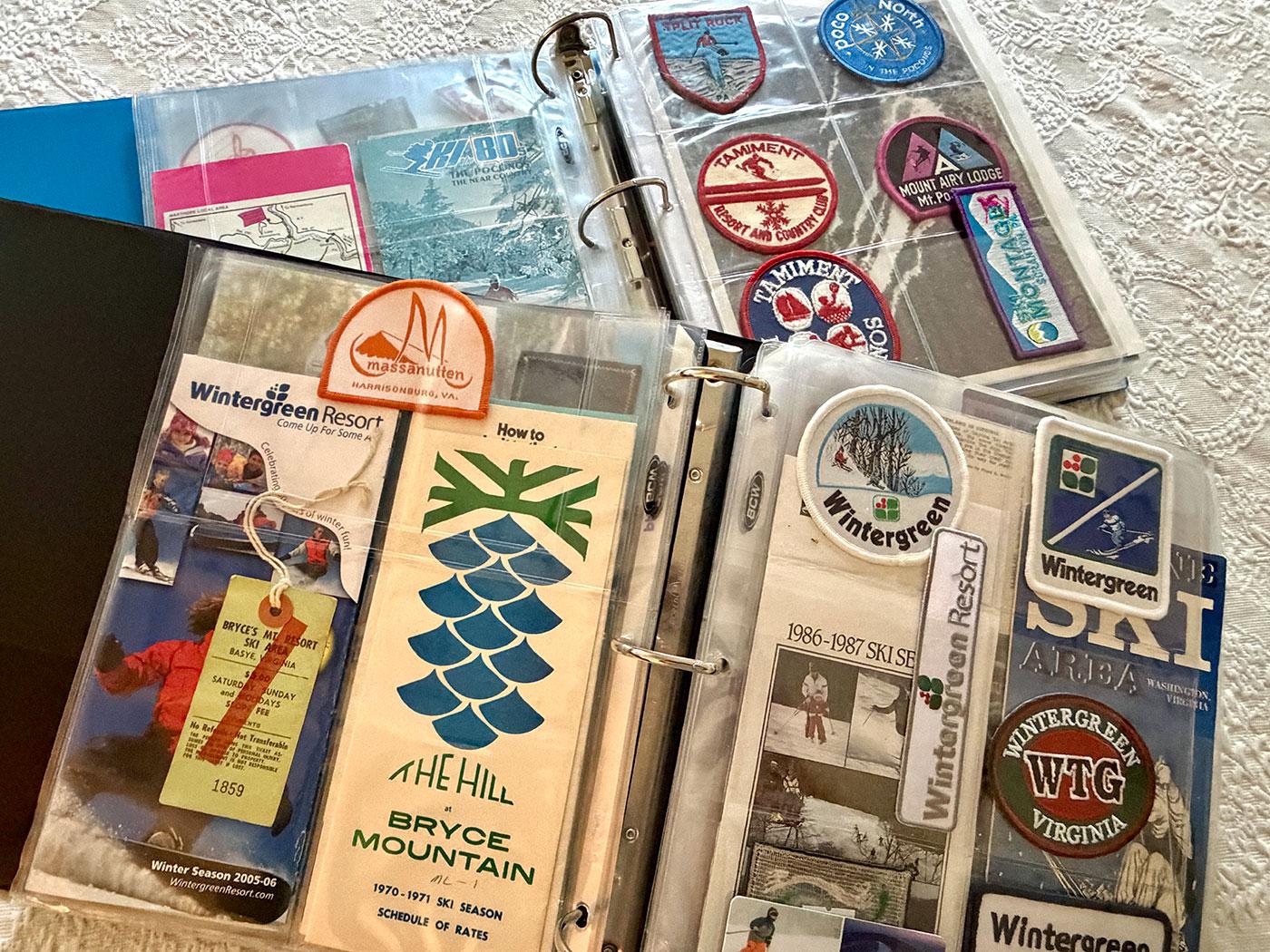
It took a while to figure out, but I eventually came up with some displays of ski pins and patches. They’re considered attractive enough to hang on our walls.
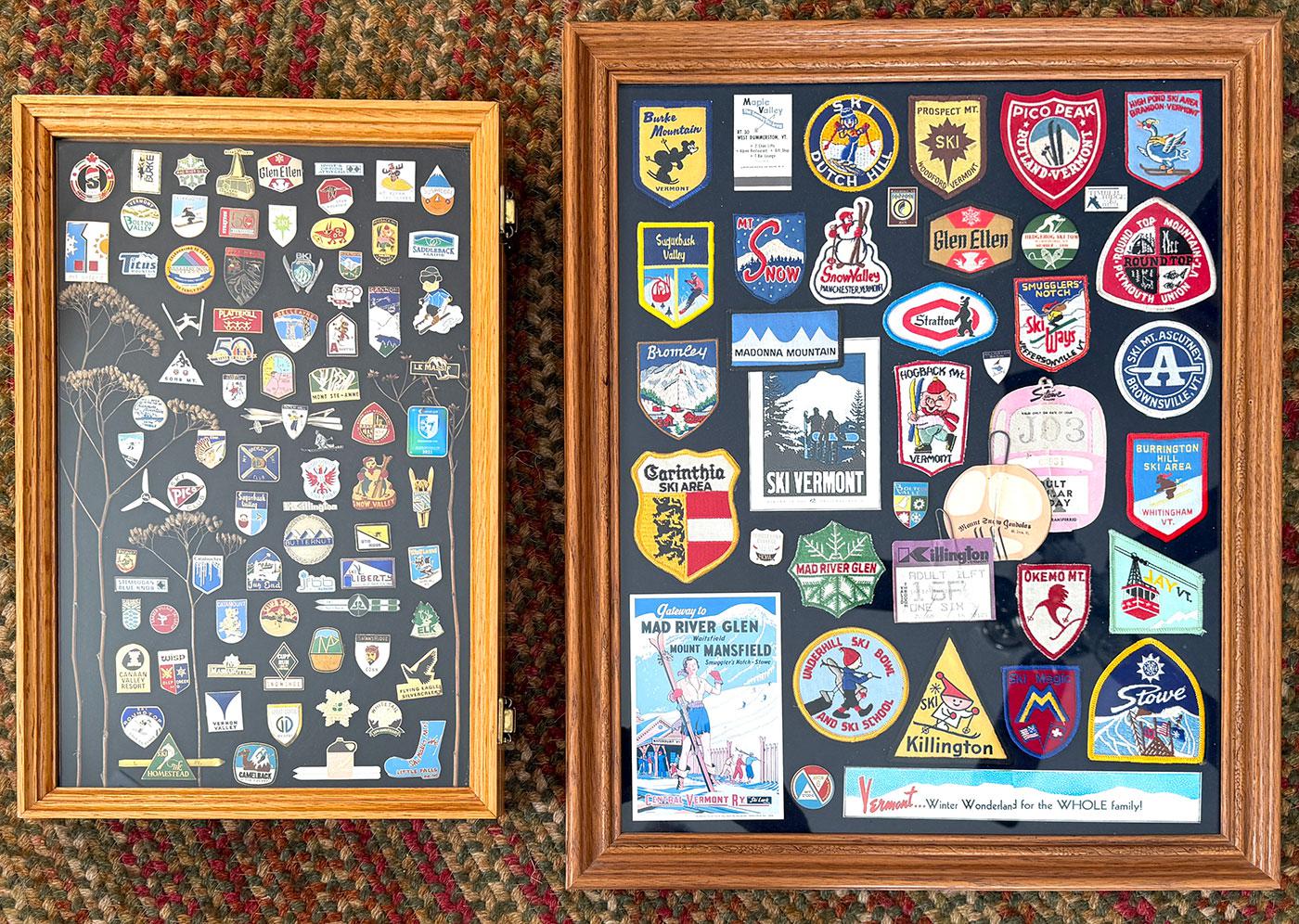
Scott: Have you connected with other ski memorabilia collectors? Is there much of an organized collecting community, or is everyone pursuing the hobby largely on their own?
Woody: I have several friends who collect ski-related items, but I haven’t bumped into any organized group on social media or elsewhere. Collectables have been an occasional topic in the Snowjournal.com forums.
Scott: Let’s turn to your family’s connection to Bousquet Ski Area. For readers who know little about that history, can you take us back to the beginning and explain how your family became involved in creating a ski area?
Woody: My paternal grandparents Clarence (Clare) and Margaretha (Marge) Bousquet bought a farm on the north-facing slopes of Yokun Mountain in Pittsfield, Massachusetts in the late 1920s. Grandpa’s primary source of income wasn’t farming, though. He and his brother ran “Charlie and Charlie,” a prominent auto supply and sporting goods store on West Street in downtown Pittsfield. The farm was mostly for subsistence, but Clare also raised and sold mink — the market for which pretty much disappeared when the Depression hit.
In 1932, members of the Mount Greylock Ski Club approached Clare for permission to ski on some of the farm’s open meadows. They eventually worked together with our family to cut ski trails through the forests on the mountain’s upper slopes. February 10, 1935 made ski history.
Nearly 500 skiers arrived at noon on the Snow Train from Grand Central Station in New York City and made their way to the family property on Yokun Mountain. They walked up and skied down. Reports were that local spectators outnumbered “those crazy skiers” by at least 4 to 1.
That fall, after learning about a ski tow in Shawbridge, Quebec and the one on Gilbert’s Hill in Woodstock, Vermont, Clare built his first rope tow for what was to become Bousquet Ski Grounds.
My dad remembers the family discussion about ticket prices. Admission to the slopes had been 25 cents. Could (and should) they charge a whole dollar for a skier to use the new rope tow? The price went to a dollar. Nobody seemed to balk at paying for the opportunity to ski down without climbing up.
Night skiing began in 1936, thanks to floodlights installed with the help of Mt. Greylock Ski Club members who were also engineers at General Electric in Pittsfield. By the late 1940s, Bousquet’s had 10 rope tows, allowing them to claim the world’s greatest uphill transportation capacity.
Scott: Who were the principal members of your family involved with the ski area, and what roles did they play in establishing and operating it?
Woody: My grandfather Clare Bousquet was the founder, but especially in these early days of skiing several family members pitched in. Grandma Marge Bousquet, a nurse, provided all-around support by organizing food and, of course, caring for injured skiers. During busy Snow Train visits, Marge’s sister Leonora cooked hamburgers in the Bousquet garage, while her husband Art Ferry sold ski tickets. My dad Russ became co-manager in 1946, and his brother Paul joined the management team in 1951.
The family operated Bousquet’s for nearly a quarter-century, selling it in 1956. While my dad Russ left the ski business, Uncle Paul sold ski lifts for Poma North America, oversaw operations at Killington, and then returned to Bousquet’s when he formed a small corporation that owned and operated the area from 1968-1981.
Scott: As you noted earlier, you were only two and a half years old when the ski area was sold. Since you were too young to remember that era yourself, how was the story of the ski area passed down to you?
Woody: Our family visits and holiday gatherings often became times to share stories. Thanks to my mom and grandmother, many of those stories were supplemented by the family photos and newspaper clippings they’d saved. My grandparents retired to Florida but visited us in the spring and fall. They liked to catch up with their Pittsfield friends, so I heard many stories about the ski area then.
Scott: What stories about the early years did you hear most often from your parents or other relatives? Were there particular events, personalities, inventions, or challenges that became part of your family lore?
Woody: I’ll share a few stories. Removing tree stumps from newly cut ski runs was difficult and time-consuming. Grandpa used dynamite. He loved to set it off (who wouldn’t?) with the classic plunger and wire coil setup to create an electric current that runs through wires to the blasting caps.
Every time you do that, you blow off a section of wire. That brought you closer and closer to the dynamite every time you re-rigged the setup. Eventually, his wife Marge would head over from the house and yell, “Clare, be more careful. Put on some more wire!” Remember that she was a nurse.
The ropes for the rope tows were made by the Plymouth (MA) Cordage Company. Clare ordered the rope he needed through the warehouse at Montgomery Ward’s in Albany, New York. Once, after waiting a month or two to receive the rope he’d ordered, he and my dad decided to drive over to Ward’s and pick it up themselves. When they got to Albany and asked about the order, the clerk said something like, “Oh, we thought your order was a joke. Nobody buys that much rope.”
The rope came in two large coils that they brought back to Pittsfield. If you’ve ever uncoiled a ball of twine, you know that you have to find an end first. Well, Clare hauled the two coils up to mid-mountain and began pulling out one of the ropes. He started at the wrong end. Shortly afterwards, he found that he’d created a twisted, knotted mess of heavy rope.
Clare came down the mountain and returned with my dad. They used a horse to help drag out and untangle the rope and spread it out up and down the ski slopes. It took until the end of the next day. Clare was more careful handling his second coil of rope.
The Mount Greylock Ski Club held an annual mid-summer banquet for its members. One year in the late 1930s, each couple who came to the banquet received a numbered ticket. Most of them thought that the tickets were for door prizes. At the end of the meal, they were informed that each number corresponds with a numbered tree stump on a new trail the club had helped cut at Bousquet’s. Each attending family’s assignment was to remove their stump by Thanksgiving so that the trail could be skied when the season opened.
I can’t skip two inventions. In the early years, skiers’ winter clothing sometimes became tangled in the twisted strands of the tow rope. Clare invented a gadget that you see on every ski lift even today: the safety gate. The design is simple: a post, a bar, a switch, and some wiring. The safety gate gets triggered and shuts off the machinery if a skier is caught in the lift or tow while unloading at the top. More than once I’ve looked up at a safety gate after having a problem at the end of a ski lift and murmured, “Thanks, Grandpa.”
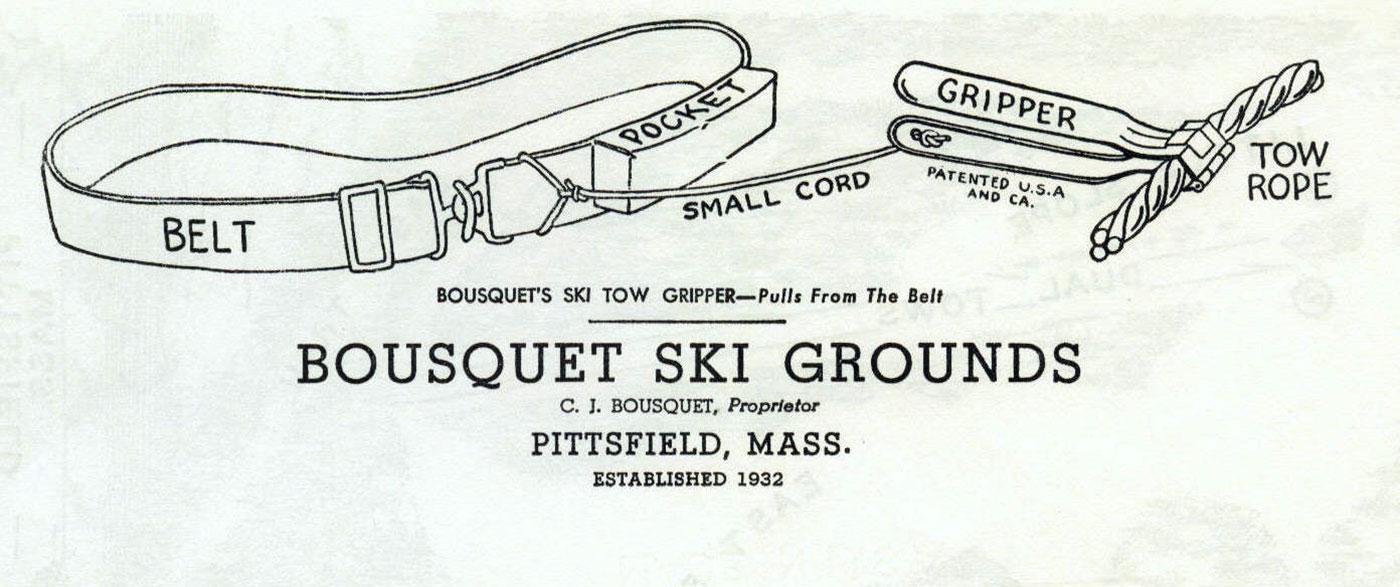
The more famous invention was the Bousquet Ski Tow Rope Gripper that Clare patented in 1941. Other nutcracker-type tow grippers were in use, but Clare’s gripped the rope better, disengaged automatically when the skier let go, and was connected to a canvas belt so that it pulled you from the waist instead of exhausting your arms and shoulders.
My mom was one of the family members who sewed the canvas belts and attached the metal grippers in an outbuilding called the Gripper House. More than a half-million of the grippers were sold in three decades, sometimes outpacing ski ticket sales at Bousquet’s during a given season.
Scott: Did your father ever talk about the decision to sell the ski area or how he felt about watching it continue under new ownership?
Woody: Yes. Snow trains became less popular when more people acquired cars and roads improved. While Bousquet’s was a pioneer in the ski business, larger ski areas were established after World War II and competed for skiers. They added new types of lifts – T-bars, poma lifts, and eventually chairlifts – plus more comfortable base lodges, heated restrooms with running water (imagine the early days…), and other conveniences. Those weren’t high priorities to my grandfather.
Operating a ski area didn’t allow much time for family during the fall, winter, or early spring. My dad Russ had learned a great deal about business through his work at Bousquet’s, but he was glad to be out of the demanding, seasonal work when the property was sold.
Scott: You mentioned that your father continued splicing ski-tow ropes after the family sold the area, and that you sometimes accompanied him. What do you remember about those trips, the work he performed, and the ski areas you visited?
Woody: Splicing ropes involves braiding the two ends of the ski-tow rope together to form a continuous coil. The work occurred after dinner, often during midwinter. I remember being cold but enjoying helping Dad do something unusual related to skiing.
It’s best to have four people when you’re splicing because you have to keep track of the multiple strands of the tow rope as they’re unbraided and then woven together. The ski areas I remember visiting with my dad were all in western Massachusetts: Berkshire Snow Basin, Oak ‘n Spruce Resort, and Bousquet’s.
Scott: Have you maintained a personal relationship with Bousquet Mountain over the years? When you return today — or encounter an old photograph or artifact from the area — what emotions does that bring up?
Woody: I can’t help smiling when I see an old photo in a magazine article or find a Bousquet artifact in a ski museum. I usually recall an old story, a family personality, or a place on the mountain.
I left Pittsfield when I went off to college, and, as I said, that change opened up a 30-year gap in my skiing until our children took up the sport.
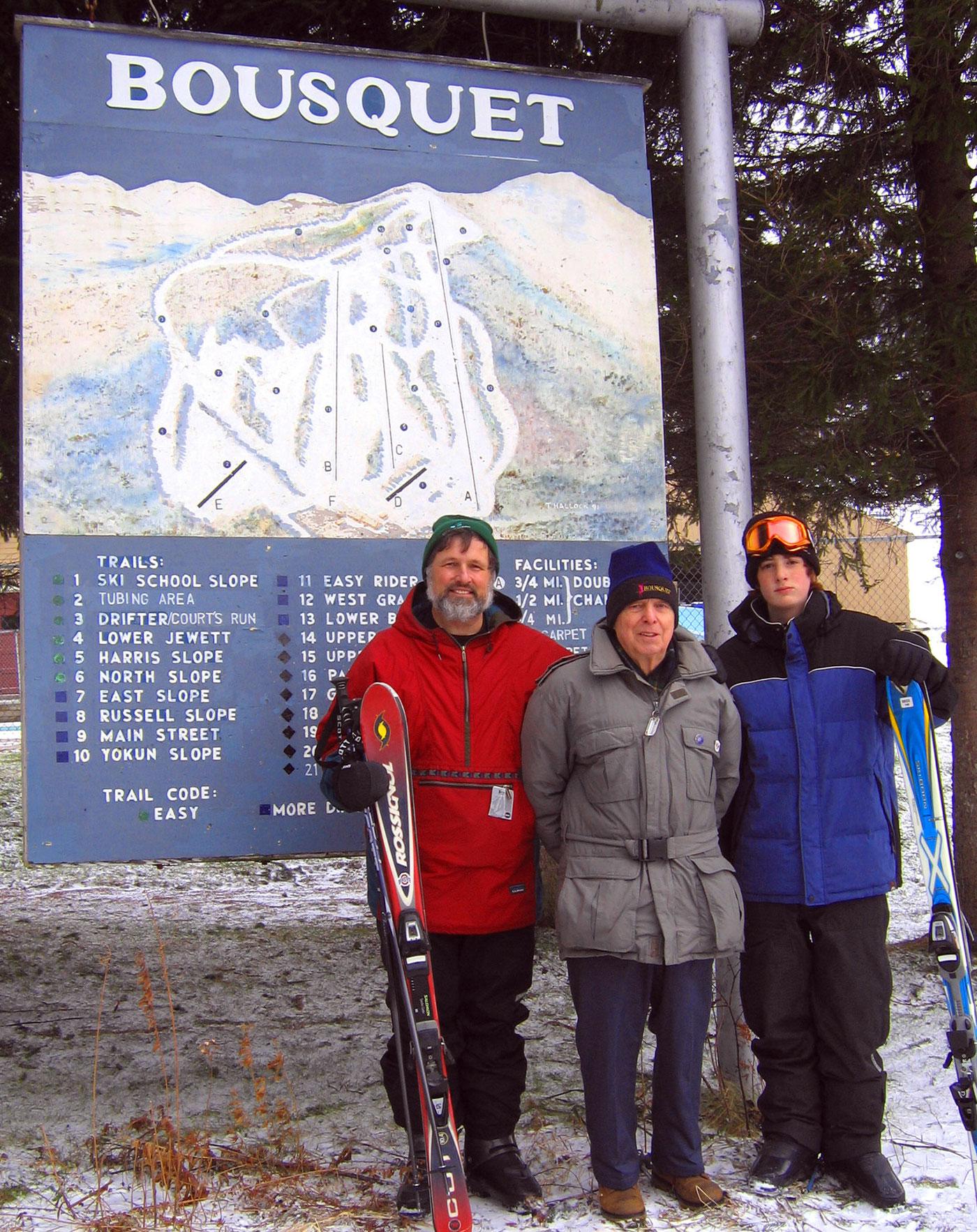
I have followed with interest the changes at the ski area, though. We held the celebration of life for my mom in the Bousquet base lodge in 2019. I’ve cheered for members of the Bousquet Ski Team who went on to become members of the US team and, in three cases, competitors in the Winter Olympics.
I have also met most of the past owners, and I enjoyeded skiing at Bousquet Mountain as recently as 2025. My plan is to stop by and ski some runs this coming season as well.
Scott: Looking back on everything you have learned, what aspect of your family’s place in skiing history makes you proudest?
Woody: My grandfather was a pioneer who, with his family’s support, left an indelible mark on skiing. He was a creative tinkerer who jury-rigged engines and developed ski-related conveniences, and he was a promoter who recognized the importance of advertising and publicity.
My dad was the loyal eldest son who got up early and worked late to support the family business. I remember after he left the ski area, that he and I were both excited to see lights for night skiing reach the summit of Bousquet’s around 1970. We could see the uppermost few lights from our house, about two miles away. I’m pleased and proud that the ski area continues to operate today, and that it honors its history by carrying the family name forward.
Scott: Thank you, Woody, for sharing so much of your own history with us. Your family’s connection to the early days of skiing gives you a unique perspective, but just as meaningful is the work you’ve done to preserve the history of so many other ski areas through your collecting and your contributions to DCSki Lost Ski Areas.
The Complete DCSki Interview Series:
- Woody Bousqet, a Lifetime Connected to Skiing’s Past
- Kevin Thomas, Creator of a Private Backyard Ski Hill
- Spencer Allen, a World Traveler with a DCSki Connection
- Pete Tolsdorf, Creator of SkiTripPlanner.com
- Ted McDowell, General Manager of Roundtop Mountain Resort
- Matt Knott, Owner of Snow Riders
- Chip Chase, Founder of White Grass Ski Touring Center
- Kenny Hess, Director of Sports and Risk Management at Massanutten Resort
- Jimmy Petterson, author of Skiing Around the World and traveler to ski resorts in over 70 countries
- Jeff Lifgren, Vice President and General Manager of the Vail Mid-Atlantic Region and Pennsylvania’s Liberty Mountain Resort
- Jamie Storrs, Senior Manager of Communications, Eastern Region of Vail Resorts
- Phil and Tricia Pugliese of Pugski.com
- Chris Diamond, Author of Ski Inc. 2000 and Former Steamboat President
- Peter Landsman, Founder and Editor of LiftBlog.com



Reader Comments