
It also created a peculiar problem for those of us who wrote about the sport: What, exactly, were we supposed to call everyone?
For decades, the terminology had been straightforward. People went skiing at ski areas, riding ski lifts to the top of ski slopes. They were skiers.
But as snowboarding grew, referring to everyone on the mountain as a skier became increasingly inaccurate. Snowboarders, understandably, didn’t necessarily appreciate being lumped into that category.
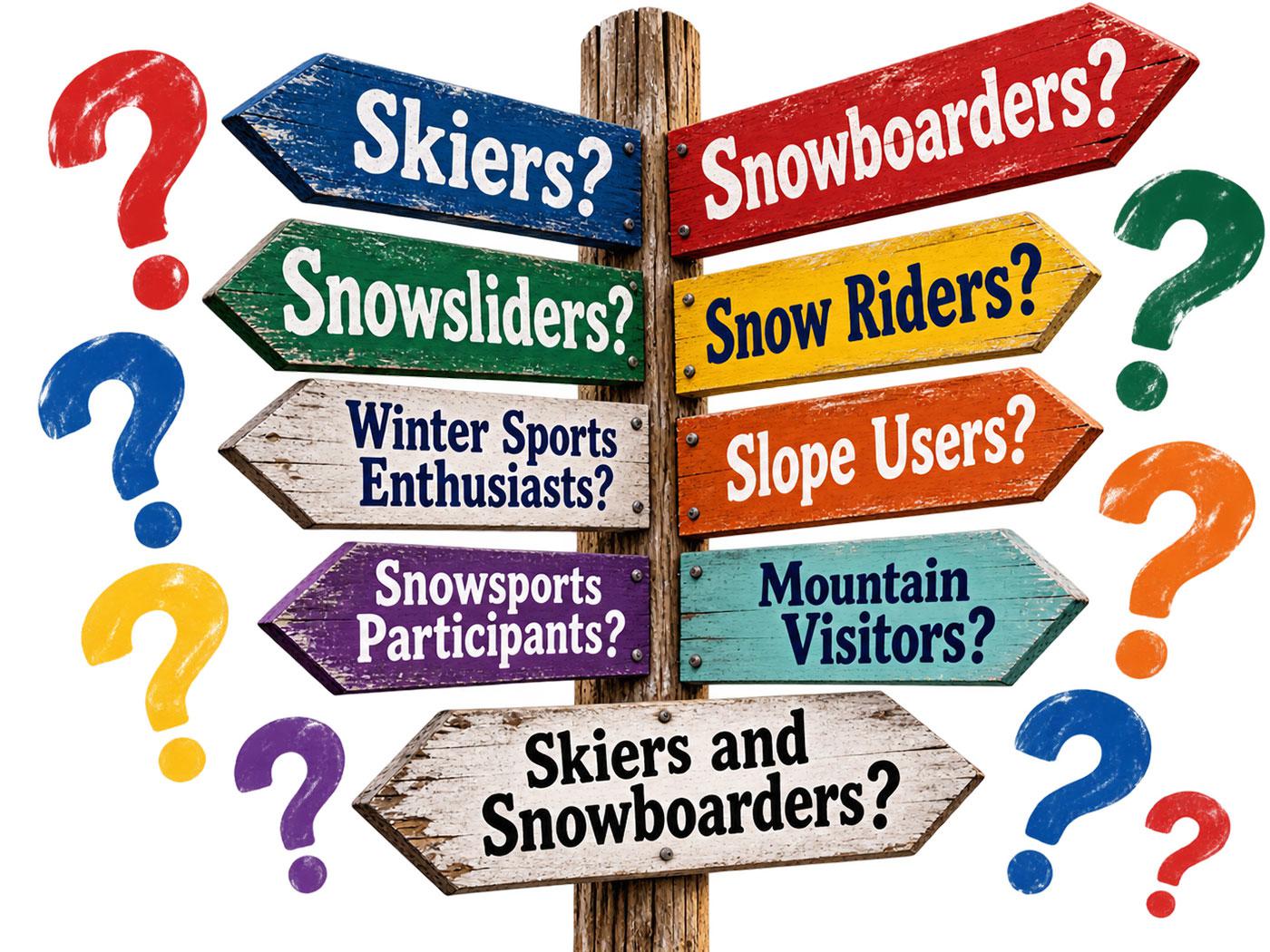
The obvious solution was to write “skiers and snowboarders,” and that’s what most of us did. But the phrase could get cumbersome, particularly when it appeared repeatedly in the same article. As a writer and editor, I found myself constantly looking for alternatives.
The Search for a Better Word
As a member of the North American Snowsports Journalists Association (NASJA), a professional organization for journalists covering skiing and other winter sports, I remember this being a recurring topic of discussion among colleagues. For several years, the snowsports journalism community seemed to be having something of an identity crisis, fretting over how to describe the people we were writing about. Surely there had to be a concise, inclusive term for everyone enjoying the slopes, regardless of their equipment?
One possibility was “winter sports enthusiasts,” which had the advantage of being inclusive and the disadvantage of sounding like something written by a committee.
It was also rather imprecise. After all, hockey players, figure skaters, and curling enthusiasts could reasonably claim membership in that group.
Another suggestion was “snowsliders.”
It made a certain amount of sense. Skiers slide on snow. Snowboarders slide on snow. So do telemark skiers, adaptive athletes, and people riding various other contraptions down a mountain. Why not call them all snowsliders?
Well, mainly because nobody talks that way, and it sounded kind of ridiculous.
Other terms were floated over the years, including “snow riders,” “slope users,” and “snowsports participants.” None seemed especially appealing. You can invent a new word, but getting people to use it is another matter, particularly when it sounds awkward in everyday conversation.
An Evolving Vocabulary
The ski industry was wrestling with similar questions. Many ski areas began rebranding themselves as mountain resorts, dropping the word “ski” from their names.
In Pennsylvania, for example, Ski Liberty became Liberty Mountain Resort, while Ski Roundtop became Roundtop Mountain Resort. Industry organizations increasingly embraced the broader term “snowsports,” reflecting the growing diversity of activities taking place on the slopes.
I briefly considered renaming DCSki DCSkiAndSnowboard.com.
I’m glad I didn’t. That would have been a terrible domain name.
Meanwhile, telemark skiing, adaptive skiing, snow bikes, and other forms of winter recreation made it even harder to find a single label that covered everyone.
Of course, “snowsports” works well when referring to the industry or winter recreation more generally. And sometimes the simplest solution is to rewrite the sentence. There’s no particular reason to write that “skiers and snowboarders can purchase lift tickets online” when “lift tickets can be purchased online” conveys exactly the same information.
There are also occasions when more specific terminology is appropriate. An article about snowboard equipment should refer to snowboarders, while a story about a ski race should refer to skiers. Most of the time, context makes the choice straightforward.
After years of searching for something better, the snowsports journalism community seems to have ended up right where it started. The phrase that came most naturally to us in the first place — “skiers and snowboarders” — remains the one most of us use today.
All that fretting, all those proposed alternatives, and we ultimately stuck with the obvious solution.


Reader Comments