
They had taken off, Connie wrote, “like a couple of snowshoe hares.”
Connie had to catch them.
DCSki has been writing about adaptive skiing for nearly three decades. The earliest stories introduced readers to equipment such as mono-skis, bi-skis, and outriggers, while profiling skiers who were finding ways onto the mountain after spinal cord injuries, amputations, or other disabilities. Later stories followed the growth of volunteer organizations, dedicated facilities, wounded-warrior programs, and increasingly sophisticated equipment and teaching methods.
Together, those stories offer a history of how adaptive skiing grew in the Mid-Atlantic — and of some of the people who helped it grow.
Finding freedom on familiar slopes
DCSki first examined the subject at length in the 1998 feature “Shattering Limitations: Skiing with Disabilities.” The story introduced Bob Reuter, a Vietnam-era veteran with a spinal cord injury who had tried adaptive skiing at Whitetail Resort. The weather was miserable, but Reuter was hooked. He bought a mono-ski, began skiing at Ski Roundtop, and eventually became an adaptive instructor himself.
After completing a run without assistance, Reuter remembered thinking, “I did this completely on my own.” On the snow, he didn’t have to ask someone to move a wheelchair over a curb or negotiate a building that hadn’t been designed with him in mind.
Reuter also pushed back against the tendency to frame every run by a skier with a disability as heroic or inspirational. He wanted something simpler: to ride the lift, talk about trails, and ski with everyone else.
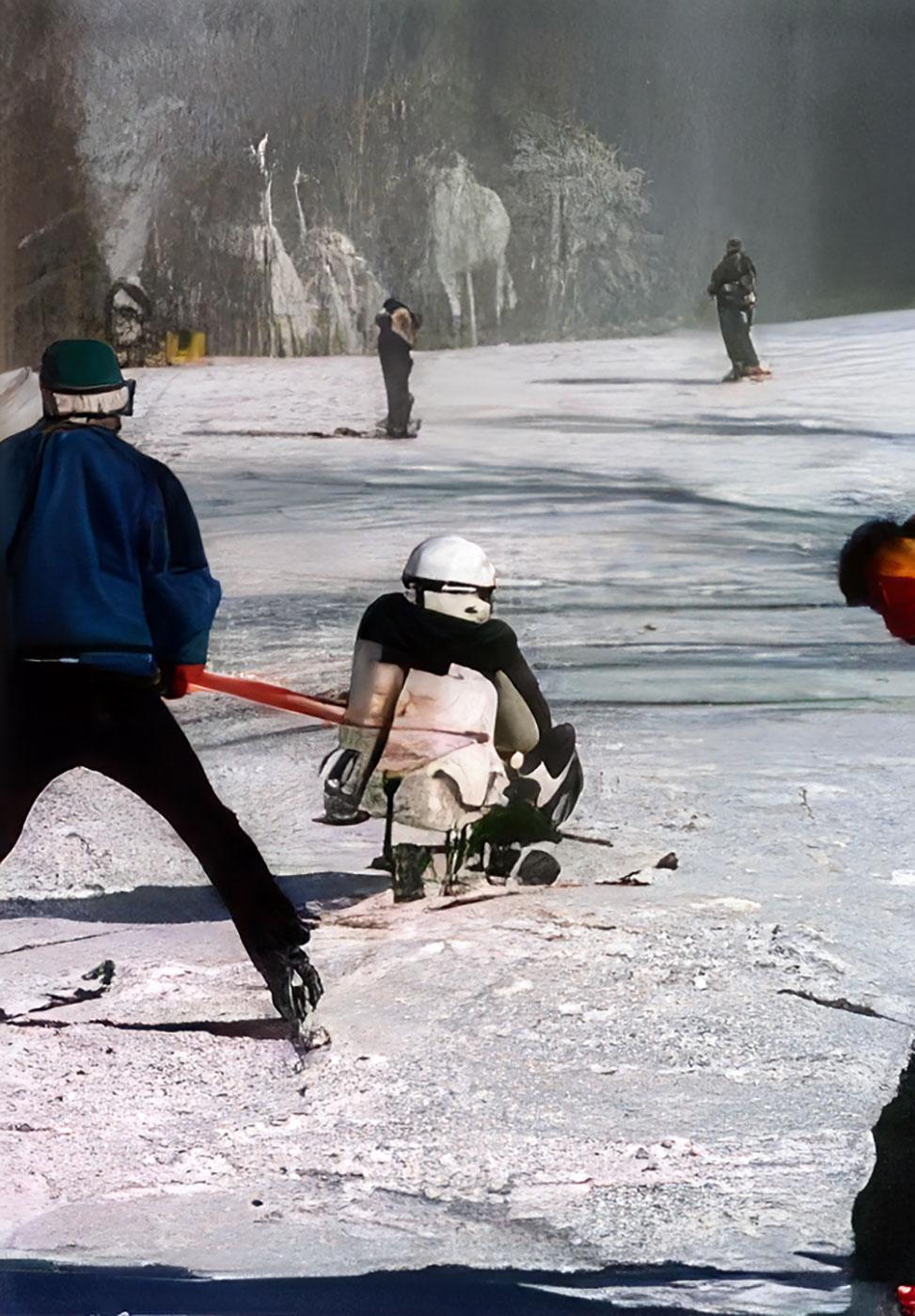
The 1998 story also visited Snowshoe, where David Begg directed an adaptive program serving people with physical and developmental disabilities as well as skiers who were blind. Among the athletes profiled was Rickie Ann McLaughlin, a young woman with cerebral palsy who skied in a bi-ski at Silver Creek. Instructors guided the equipment with tethers, adapting the lesson to her needs and abilities.
The specialized equipment was impressive, but Reuter pointed out a more mundane problem: “The hardest part of adaptive skiing is getting from the parking lot to the snow.” Stairs, heavy doors, narrow routes, snow-covered walkways, and inaccessible buildings could make reaching the lift harder than skiing back down.
Equipment was another hurdle. It was expensive, rental fleets were small, and trained instructors weren’t always available. Over the years, Mid-Atlantic programs would build larger equipment inventories, train more volunteers, and establish permanent bases at several resorts.
Adaptive skiing itself has much older roots. After World War II, veterans and instructors developed techniques that allowed amputees to ski. According to Move United’s history of adaptive sports, 10th Mountain Division veteran Jim Winthers taught two fellow veterans who had lost legs in combat to ski at California’s Donner Ski Ranch in 1953. The return of wounded Vietnam veterans helped expand the movement, along with advances in equipment and instructor training.
The Mid-Atlantic proved well suited to that growth. Ski areas were within easy reach of major population centers, rehabilitation hospitals, and military communities. Wintergreen Adaptive Sports hosted veterans and therapists from Walter Reed Army Medical Center in 2005, an early gathering that grew into its Wounded Warriors Weekend. Liberty Mountain held Warfighter weekends with Blue Ridge Adaptive Snow Sports. Whitetail’s Two Top Mountain Adaptive Sports Foundation developed its own ties to Walter Reed and the Washington-area military community.
Veterans were one part of a much larger population served by these programs. Participants included children and adults, first-time skiers and experienced athletes, and people with congenital or acquired disabilities.
Building programs — and a place on the mountain
Snowshoe provides one of the clearest examples of the growth DCSki documented. When DCSki visited in 1998, Begg was already an experienced instructor and athlete. In 1996, the nonprofit now known as Challenged Athletes of West Virginia was incorporated under his leadership.
By 2005, a slopeside Adaptive Sports Center was taking shape at Silver Creek. West Virginia businesses donated materials, while contractors working elsewhere at Snowshoe volunteered labor. The finished log building provided room for specialized equipment and gave participants an accessible base close to the slopes.
Connie documented the new center in her 2006 story, “Adaptive Skiing at Snowshoe.” At the time, the program was providing about 400 lessons a year with roughly 45 instructors, most of them volunteers. Begg, an amputee who had spent decades involved in adaptive sports, summed up the experience simply: “You feel good about what you do.”
Connie spent much of the story with the athletes. Aaron Preece, a teenager who was blind, skied with instructor Robert Martin using verbal directions and a small device that helped hold his ski tips in a wedge while he learned. Brandi Garrett and Pat Broderick used sit-skis. Broderick described skiing as a way of confronting fear “one turn at a time.”
Challenged Athletes of West Virginia continues to operate from Snowshoe and has expanded programming to other West Virginia mountains. Begg died in 2018, but the organization he helped build continues his work.
Similar efforts were growing elsewhere. At Wintergreen in 2005, Connie visited a small slopeside building packed with mono-skis, bi-skis, outriggers, and volunteers. Her report on Wintergreen Adaptive Sports described an organization expanding its programs for injured veterans and other participants while relying heavily on donations and volunteer labor.
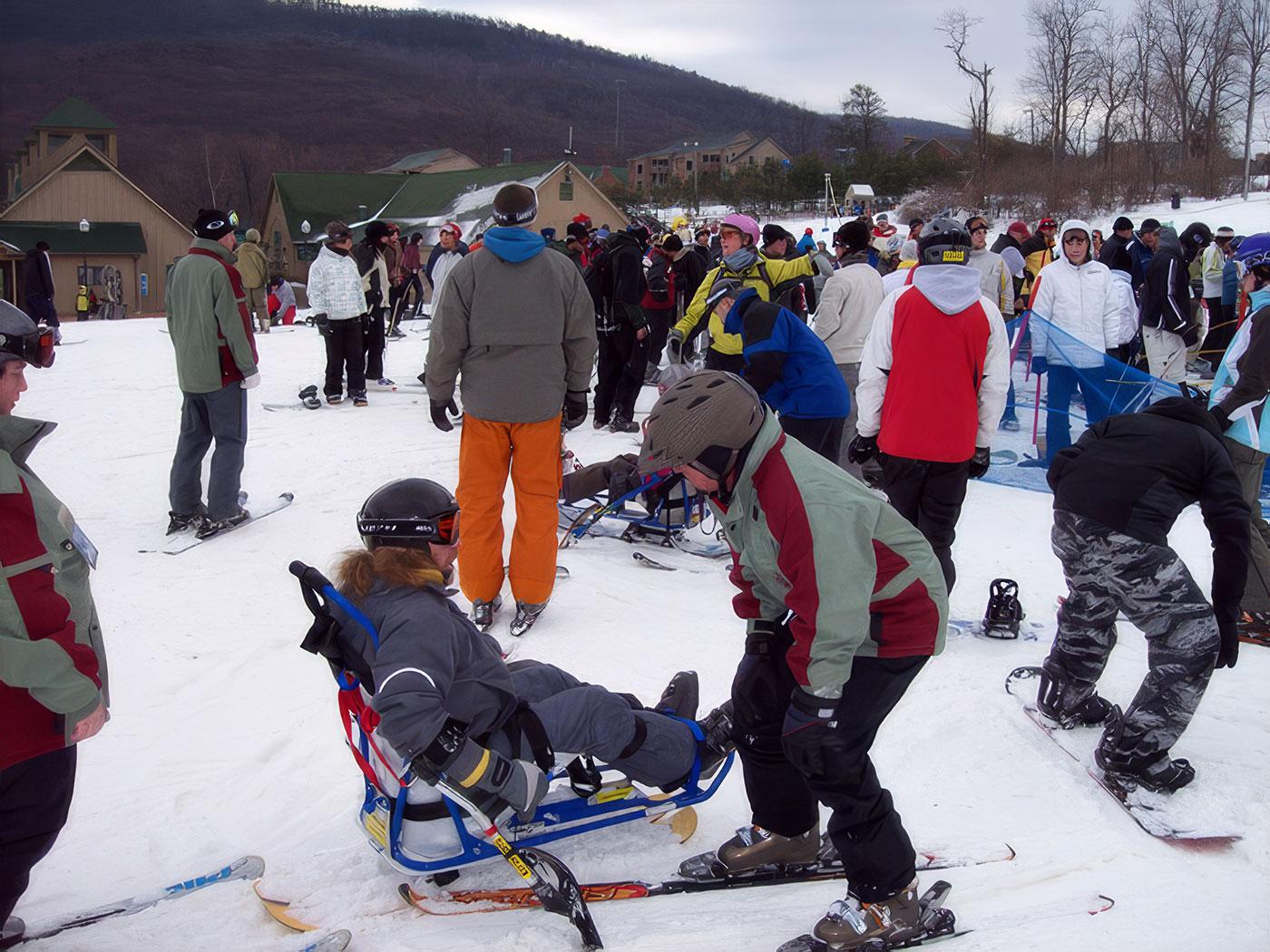
In January 2009, Connie was at Whitetail for another milestone. Her story, “New Whitetail Adaptive Sports and Wounded Warrior Program,” introduced Bill Dietrich and Two Top Mountain Adaptive Sports Foundation. About 30 volunteers gathered for specialized training, some of it led by athletes with disabilities. Army Major David Rozelle described snowsports as “an amazing equalizer” because gravity supplies the motion.
Four years later, Connie returned to Two Top’s adaptive tent at Whitetail. Its headquarters were still modest, but the program had provided about 200 lessons that winter. Its growth depended on the same combination seen elsewhere around the region: committed leaders, donations, specialized equipment, and volunteers willing to devote their own ski days to teaching others.
Connie’s turn
No DCSki writer covered adaptive skiing more consistently than Connie. A White House correspondent by profession and an irrepressible skier by temperament, she contributed 178 stories to DCSki over 15 years. She kept returning to adaptive programs and the people involved with them.
Eventually, her connection to the subject changed.
Parkinson’s disease gradually affected Connie’s strength and balance. In 2016, she returned to Liberty, one of her favorite local mountains, and climbed into a bi-ski with instructor Mike Casselle of Blue Ridge Adaptive Snow Sports.
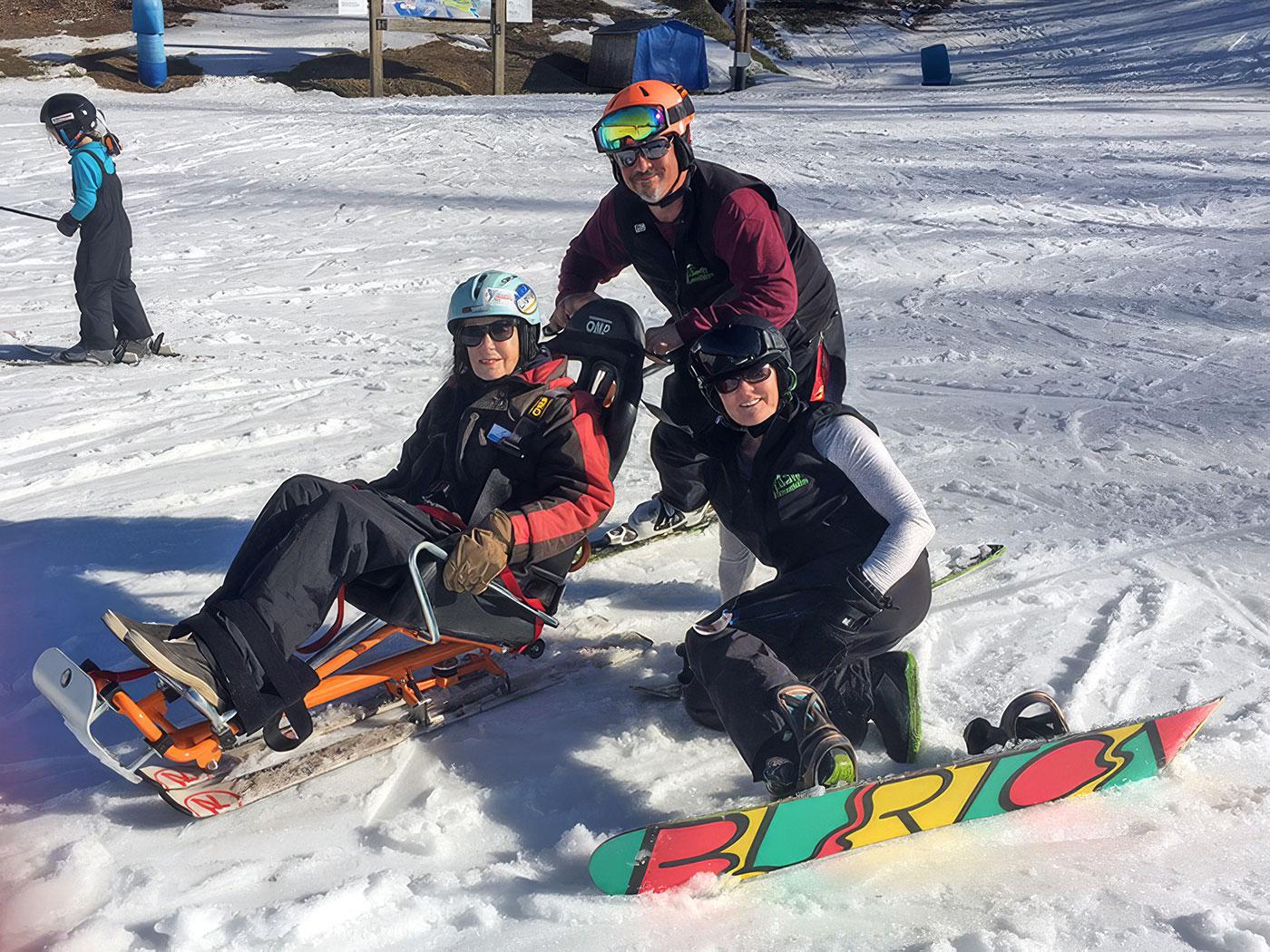
In “Adding to the Bucket List at Liberty Mountain Resort,” Connie wrote candidly about stiffness, trust, and the music that helped her relax as the lesson began. After years of following adaptive skiers around Mid-Atlantic slopes, she had joined them.
When Connie died in 2018, DCSki readers remembered her as a longtime champion of adaptive skiing who ultimately became an adaptive skier herself. Her stories preserved a period of remarkable growth, while introducing readers to the instructors, volunteers, and athletes behind it.
Adaptive skiing today
Adaptive skiing covers a wide range of equipment and teaching techniques. An instructor may consider a skier’s goals, previous experience, strength, range of motion, balance, vision, communication needs, and other factors before deciding how to approach a lesson.
Some athletes ski standing. A three-track skier typically uses one ski and two outriggers; a four-track skier uses two skis and two outriggers. Outriggers resemble forearm crutches with small ski tips at the bottom and can provide balance and turning support. Tip connectors, prostheses, braces, and other supports can also be used.
Sit-skiers may use a bi-ski, which rides on two skis and provides greater stability, or a mono-ski, with a seat and suspension mounted over one ski. An instructor can tether the equipment from behind and gradually reduce assistance as the skier develops control. Some athletes continue skiing with support, while others progress to loading lifts and skiing independently.
Skiers who are blind or have low vision may work with a guide providing directions and information about terrain and traffic. Skiers and snowboarders with cognitive, developmental, or sensory disabilities may use different lesson structures, pacing, repetition, or communication techniques. Adaptive snowboarding has expanded as well.
Instructor education has also become more formal. PSIA-AASI’s adaptive certification includes pathways covering cognitive disabilities, visual impairment, stand-up skiing, bi-skis, and mono-skis, with multiple certification levels.
The Mid-Atlantic now has a sizable network of adaptive organizations. Wintergreen Adaptive Sports offers private adaptive lessons along with veteran, youth, and warm-weather programs. Blue Ridge Adaptive Snow Sports teaches at Liberty Mountain. Two Top operates at Whitetail. Challenged Athletes of West Virginia works from Snowshoe and elsewhere in the state. Pennsylvania programs operate through organizations and ski schools at mountains including Camelback, Jack Frost, Big Boulder, and Spring Mountain.
Advance planning remains important. Programs may need to reserve specialized equipment and match a participant with two or more trained instructors. A sit-ski lesson can also involve fitting equipment, coordinating lift access, and practicing transfers before heading uphill.
Most of the work is the result of volunteers, who train, maintain equipment, raise money, organize events, and spend winter days teaching. Some lessons require considerable teamwork, particularly when tethering a loaded bi-ski or assisting with a chairlift transfer.
Other skiers can help simply by giving adaptive teams room on the trail and in lift lines, especially when tethers extend uphill from a sit-ski. Don’t ski between members of a group, and don’t assume someone needs help just because they have a disability. Speak directly to the athlete rather than automatically addressing an instructor or companion.
And don’t assume the adaptive skier in front of you is a beginner, as Connie discovered back in 2006 when her interview subjects blazed down the mountain before her.


Reader Comments