
That is quite a range for the same basic activity. The price can change with the date, day of the week, length of the session, age of the skier, and timing of the purchase. Once rentals, lessons, lunch, transportation, and RFID cards join the party, the old question becomes even harder to answer.
Ski prices in this article were checked on August 29, 2026; gasoline prices were checked on September 1. Unless noted, totals exclude taxes, transportation, and lodging. Prices and products can change, and some resorts have not released their complete 2026-2027 schedules.
The price depends on when you buy
Not long ago, a skier could pick up a brochure and find the weekday and weekend prices printed in a tidy little box. Many resorts now use advance-purchase and date-specific rates instead. Blue Mountain and Massanutten use online calendars that adjust prices with demand, while Snowshoe advises guests to buy early for the lowest rate. Vail Resorts sells its least expensive daily access through Epic Day Passes purchased before winter.
No single resort represents the entire Mid-Atlantic market, but Wisp’s detailed 2026-2027 rate sheet provides a useful example of how the pieces add up. An adult day ticket purchased in advance costs $89 Monday through Thursday, $119 Friday through Sunday, and $129 during designated holidays. At the window, those prices rise to $109, $139, and $149.
For two adults and two children ages 6 through 12, advance weekend tickets under that rate schedule total $416. Waiting to buy the same tickets at the window raises the bill to $496, so a few minutes of online planning saves the family $80 and reduces the chance that tickets or rental equipment will be unavailable on a busy day.
Some of the lowest prices require a larger commitment. As of late August, a one-day Epic Day Pass valid at Vail’s eight Pennsylvania ski areas costs $68 for an adult and $34 for a child when peak dates are excluded. A four-day adult pass costs $218, or about $55 per day, while a seven-day pass costs $323, or about $47 per day. These products are sold before the season, and the next price increase is scheduled for September 7.
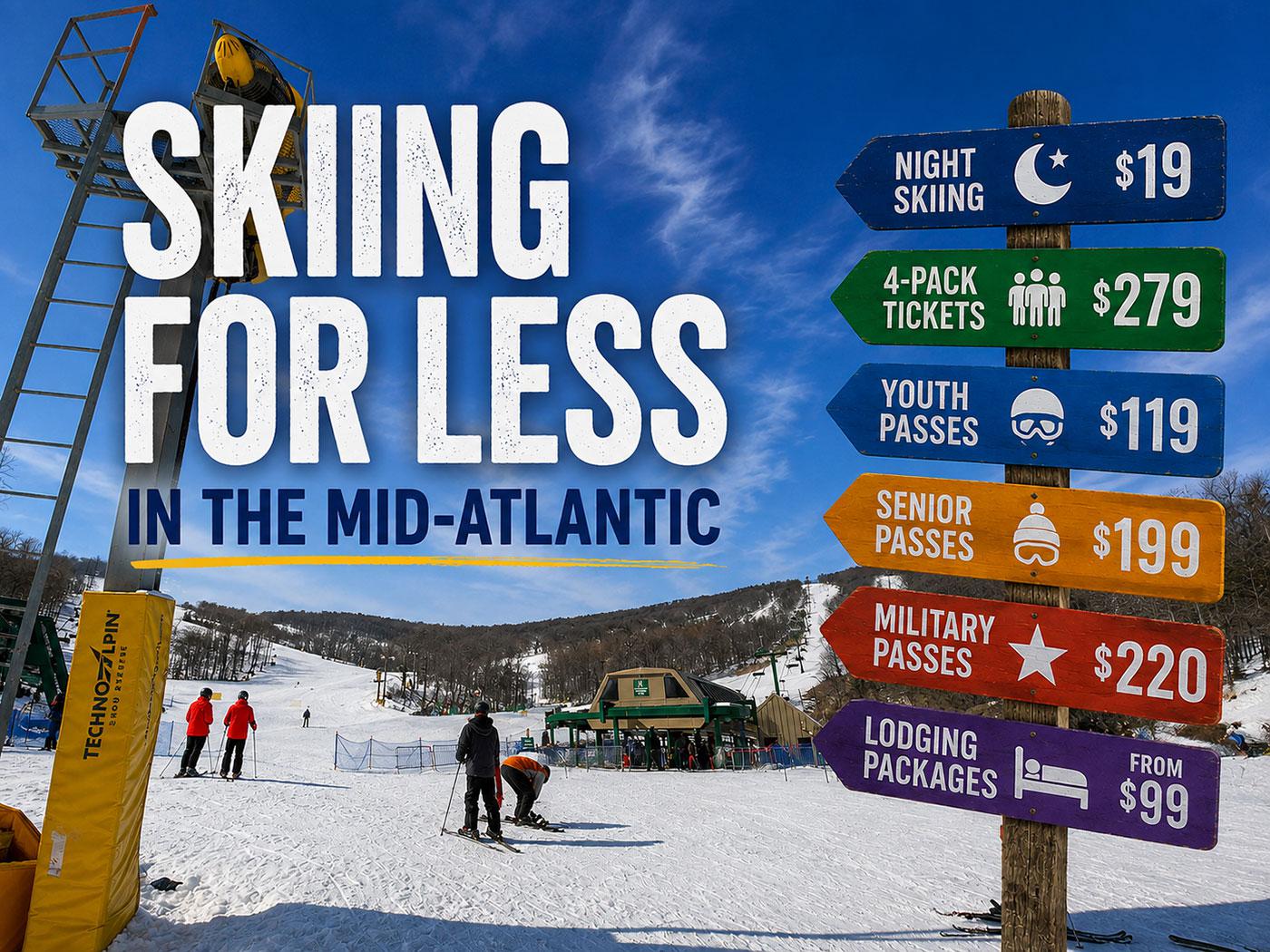
Fortunately, the start of the season does not bring an end to every bargain. Some mountains are advertising $19 night tickets, including Wednesday nights at Wisp and Thursday Local’s Nights at Wintergreen; college students will also find occasional specials. The hours and quantities are limited, but a skier with a flexible schedule can still find some remarkably inexpensive turns.
Multi-ticket products provide another option. Wintergreen’s Mission Affordable 4-Pack costs $279 and includes four transferable, unrestricted eight-hour tickets. The effective price is $69.75 per visit, and one skier can use the tickets over four days or four people can share them on the same day.
There is, of course, a tradeoff. Buying early lowers the price but commits the skier before anyone knows which mountain will catch the best storms. Waiting for the forecast preserves that freedom, usually at a higher price.
Adding rental equipment
For a skier who already has a garage full of equipment, the lift ticket will account for most of the day’s budget. A newcomer has a longer shopping list: skis or a snowboard, boots, perhaps a helmet, and enough winter clothing (something other than jeans) to remain comfortable when the chairlift stops in the wind.
Using the published rates from Wisp in the example above, an advance lift-and-rental package costs $109 for an adult on a weekday, $159 on a weekend, and $169 on a holiday. Youth packages cost $89, $129, and $139. Window purchases add $20 per person. Prices differ from mountain to mountain, but the example shows how quickly rentals change the day’s total.
Standard rental packages generally include skis, boots, and poles, or a snowboard and boots. Helmet policies vary, and jackets, gloves, goggles, and ski socks are usually excluded. A first-time visitor who owns none of those items may discover that getting dressed for skiing costs nearly as much as getting onto the snow, although of course once you’ve purchased the equipment and gear, you can reuse it repeatedly.
Off-mountain shops may charge less, particularly for several days, although on-mountain rentals are convenient when boots hurt or a binding needs attention. Families should compare the complete package price and decide whether the savings are worth another stop and a little more equipment wedged into the car.
What a family might spend
To put the numbers into something resembling a real ski day, consider two adults and two children ages 10 and 12 using that same Wisp rate sheet for a non-holiday weekend:
| Scenario | Tickets and rentals | RFID cards | Estimated lunch | Estimated total |
|---|---|---|---|---|
| Own equipment, buy in advance | $416 | $20 | $80-$100 | $516-$536 |
| Rent equipment, buy in advance | $576 | $20 | $80-$100 | $676-$696 |
| Rent equipment, buy at the window | $656 | $20 | $80-$100 | $756-$776 |
The lunch figure is a planning estimate rather than a quoted menu price, and the totals exclude gasoline and taxes. A cooler in the car can trim the bill, provided everyone is willing to trade a slopeside lunch for sandwiches in the parking lot or perhaps subsist on a collection of granola bars strategically stashed into various ski jacket pockets.
Advance products can reduce the lift-ticket portion significantly. Four tickets from Wintergreen’s $279 4-Pack, four new RFID cards, and the same lunch allowance would bring the total for a family owning equipment to approximately $379 to $399. Two adult and two child Epic Day Passes currently total $204 before adding peak-date access.
Age cutoffs are also worth checking. Wisp and Wintergreen provide free lift access to children age 5 and younger under their stated conditions, while Massanutten extends it through age 6 with a paid adult. Equipment remains an additional expense, and a child just beyond the cutoff needs a youth ticket.
The cost of learning
A first ski trip usually includes instruction as well as tickets and equipment, which makes the introductory day one of the most expensive. Beginner bundles at least provide an easy way to buy all three.
The lift, lesson, and rental bundle in our worked example includes an all-day ticket, equipment, and a 90-minute group lesson. The advance adult price is $129 Monday through Thursday and $209 on weekends and holidays. Youth pay $109 during the week and $199 on weekends and holidays.
For the same family of four learning on a weekend, the packages total $816. RFID cards and lunch bring the day to approximately $916 to $936 before taxes and travel. A window purchase adds another $80.
Promotional programs can offer a less expensive introduction. Ace’s at Wisp and Wintergreen’s Fuller Experience have provided free learn-to-ski and snowboard opportunities in limited quantities, while other mountains offer school programs, college nights, and discounted first-timer packages.
It may be tempting to save money by skipping the lesson and relying on a friend. That arrangement has ended more than a few friendships at the top of a beginner slope. A well-priced lesson package is generally money better spent.
Season-pass arithmetic
Season passes invite their own kind of preseason arithmetic: divide the price by the number of days you expect to ski, convince yourself the resulting figure is a bargain, and hope winter cooperates. Several prominent local passes currently cost between about $580 and $680. Wintergreen’s Mission Affordable Pass is $579 through September 7 before increasing to $659, and includes unlimited skiing at Wintergreen and Wisp. Snowshoe’s unlimited local pass is $619 for adults. Timberline’s Perfect Season Pass is $636 for adults and includes sister resorts Perfect North Slopes and Swiss Valley.
Vail Resorts’ $676 Northeast Value Pass covers all eight Vail-owned Pennsylvania ski areas without local blackout dates. It also provides access to other northeastern resorts under varying restrictions. DCSki’s recent guide to Epic, Ikon, Indy, and local passes examines these products in greater detail, including the limited-day options that may suit occasional skiers better than a full season pass.
Compared with daily prices of roughly $90 to $130, a $600 to $700 pass can recover its cost in five to eight visits. A weekday skier comparing the pass with discounted tickets will need more days; a weekend or holiday skier will need fewer. Food, lodging, lesson, rental, and companion-ticket discounts can add value when a passholder uses them.
The calculation works best when it is based on realistic plans rather than September optimism. A discounted pass purchased for ten hoped-for visits becomes an expensive souvenir if work, family obligations, or weather limit the season to three.
Beyond tickets and equipment
Then there is the trip itself. For Washington-area skiers, that can mean a relatively short drive to Liberty or Whitetail or a weekend journey to Snowshoe. Fuel, tolls, and vehicle wear remain part of the cost, even if they are easier to ignore than the charge on a lift-ticket confirmation. Carpooling helps divide that expense.
Fuel is a larger concern heading into this winter. On September 1, AAA listed the average price of regular gasoline across the Washington metropolitan area at $3.98 per gallon, compared with $3.09 a year earlier. That is an increase of about 88 cents, or 29 percent. AAA has attributed this summer’s high national prices to expensive crude oil and continued volatility affecting shipping through the Strait of Hormuz.
No one can say where prices will be when the lifts begin turning. For a rough idea of the added expense, the DCSki Resort Profile for Snowshoe estimates the drive from Washington at 229 miles each way. An SUV averaging 22 miles per gallon would use about 21 gallons on the 458-mile round trip. If all of that fuel were purchased at the Washington-area average, the trip would cost about $83 today, compared with $64 at last year’s price—roughly $19 more. Actual costs will depend on the vehicle, route, and where the driver fills the tank, but several trips during the winter could make the increase noticeable.
Most Mid-Atlantic ski areas continue to offer free general parking, although premium options may carry a charge. Snowshoe, for example, has used free remote lots with shuttle service alongside paid parking choices. Visitors should review the current plan before traveling.
Food offers one of the easiest opportunities to save. Breakfast on the road followed by lunch, snacks, and drinks at the mountain can add well over $100 for a family. Eating before departure or carrying lunch can reduce that amount where resort policies and parking access permit.
An overnight stay raises the total but can replace a tiring drive and allow two days of skiing. Resorts frequently bundle lodging with lift tickets, especially during non-holiday midweeks, and those packages can cost less than buying the room and skiing separately. Availability and restrictions vary, so it is worth comparing the package with the resort’s regular ticket price before booking.
Equipment owners also absorb costs over time. Skis need tuning, boots wear out, and helmets and clothing eventually require replacement. Those expenses are spread across a season rather than collected at the ticket window.
Ways to save some money
Buying before the season can produce the lowest daily price, while online purchases during winter commonly save $10 to $20 per person. Weekdays, nights, and non-holiday periods usually cost less. Reusing an RFID card, packing food, and sharing the drive provide smaller savings on each visit.
DCSki recently surveyed many of the region’s strongest discounts in “Where Can You Still Ski for Less? The Mid-Atlantic’s Best Values.” The list includes inexpensive night tickets, off-peak and local season passes, programs for children and seniors, military discounts, beginner packages, and lodging deals. Many come with deadlines, blackout dates, or narrow eligibility rules, so finding the bargain is only the first step; reading its terms is the second.
The lowest advertised price is not always the best deal for a particular skier. A short evening ticket will not help someone who can visit only on weekends, and a deeply discounted pass loses its value when it goes unused. As the DCSki pass comparison found, the right product is the one that matches the days a skier is likely to take and the resorts that are practical to reach.
There is no disguising the fact that skiing remains expensive for a family needing tickets, rentals, and lessons. Still, the difference between buying early and arriving at the window on a holiday can reach several hundred dollars. A little planning may not make a ski day cheap, but it can leave enough money for another day on the slopes—which is usually where a skier would prefer to spend it.



Reader Comments