
The downsides, however, include longer lines at ticket windows, rental counters and lift lines, as well as more crowded trails and an increasing risk of being run over by “hot-dogging” fellow winter-sports enthusiasts. How many DCSki.com readers have come close to be being slammed or actually have had the unpleasant experience of being run over? Because of the increased hazards, more areas are implementing measures to bring safety back to the slopes.
Reducing hazards does not simply make sense from a customer satisfaction standpoint. Actively controlling reckless skiing and boarding leads to fewer accidents, which leads to fewer injuries and lowers liability risk for ski areas. This, combined with greater customer satisfaction translates into healthier returns for ski areas. One of the greatest examples of areas that have consistently enforced safe skiing and boarding is Vail mountain resort in Colorado. Vail uses a combination of clever signs (“Space, Not Speed”), strategic “slow zones” and “yellow jacket” safety patrols, along with their ski patrol to enforce the message that customers are required to ski and ride in control at all times.
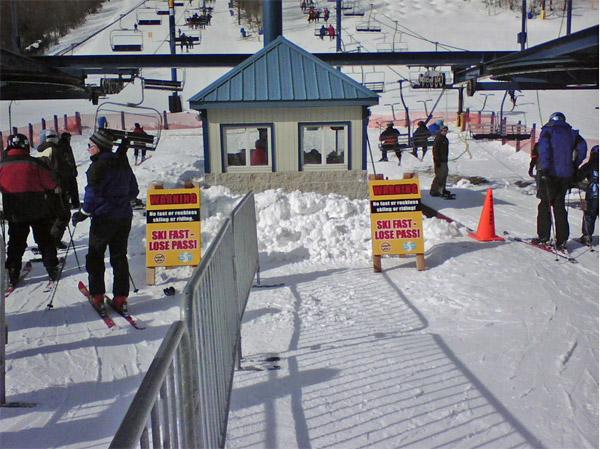
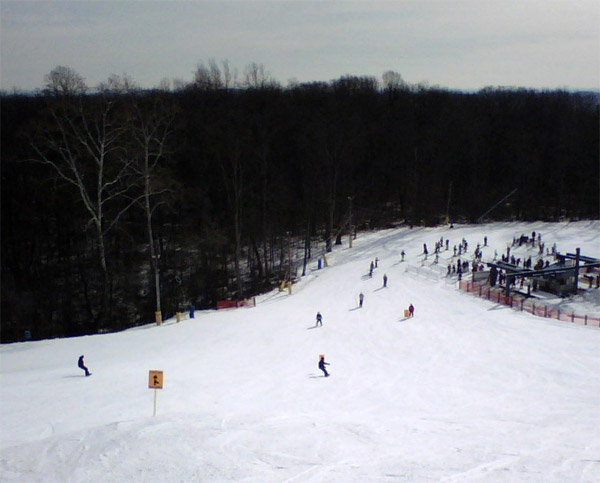
Closer to home, local areas are also getting involved with proactive safety. The most recent and perhaps notable example involves the area closest to the D.C. metro area, Liberty Mountain. Approximately three weeks ago, Liberty Mountain began an active campaign of safe skiing and riding designed to enhance safety on the slopes. The campaign includes new signs informing visitors that skiing and boarding are fun sports that still must be enjoyed responsibly. Signage on slopes is also increasing, indicating where trails merge and where slow skiing/riding areas are located.
|
|
The Strata and Eastwind Quad chairlifts on the backside of Liberty Mountain Resort. Photo provided by Jim Chen.
|
|
|
Some of the new signs appearing at Liberty Mountain Resort -; this at the base of Ultra (note the patroller standing by the “SLOW” sign). Photo provided by Jim Chen.
|
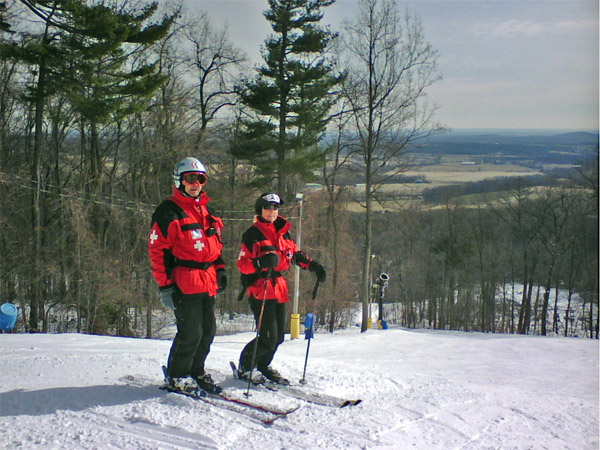
Along with the new signs, Liberty’s Ski Patrol and Mountain Safety are actively policing, looking out for reckless skiers and boarders and, where necessary, revoking lift tickets. Reckless skiers/boarders finding themselves in that situation may return to skiing/boarding, but only after completing a mandatory skier/boarder re-education class -; sort of a “traffic school” for those caught skiing or riding out of control. Of course, this all begs the question of how does Liberty Mountain define “reckless skiing/riding?” Based on a recent newsletter to customers, the Area defines such behavior as including some of the following:
- Skiing faster than the flow of traffic. For example, the speed limit on the highway may be 65, but when everyone else is going 40 mph and you weave in and out of the lanes going 65, that is reckless.
- Skiing in a manner that prevents you from stopping quickly.
- Skiing fast on a green or blue trail.
- Skiing on a trail that is above your ability level.
- Stopping in the center of the trail or where you can’t be seen from above.
Signs posted around the Area also give additional examples such as:
- Straight line running down a trail (i.e., no turns).
- Collisions with anything other than the ground (i.e., other customers or equipment).
- Skiing or riding too close to other customers.
Simply put, Liberty Mountain’s campaign expects everyone to ski or ride in control and follow the Responsibility Code.
|
|
Liberty Mountain patrollers Joerg Meyer and Suzy Nicol monitoring the slopes. Photo provided by Jim Chen.
|
With the campaign three weeks old, the question then becomes is this all worth it? If you ask that of Liberty Mountain’s management, the answer is a resounding yes. Based on discussions with both Eric Flynn, Liberty Mountain’s General Manager and Lonny Whitcomb, Liberty Mountain’s Risk Manager, the effort has already paid off in the form of a dramatic decrease in the number of injuries requiring patroller treatment and positive customer feedback. Patrollers enforcing the reckless skiing/riding ban have also reported being approached by customers on the slopes who thank them for their efforts.
Based on these types of results, it is likely that Liberty Mountain will continue its campaign to encourage fun, but safe skiing and riding. Skiers and boarders seeking adrenaline-rushing thrills with big air, rails and other features will still have the terrain park and half pipe (now both 100% open), and faster skiing/riding will be available on the expert slopes, but Liberty Mountain’s emphasis on safer skiing/riding for everyone should mean more fun for those seeking a less hair-raising experience, especially on the beginner and intermediate runs!

Reader Comments