
|
|
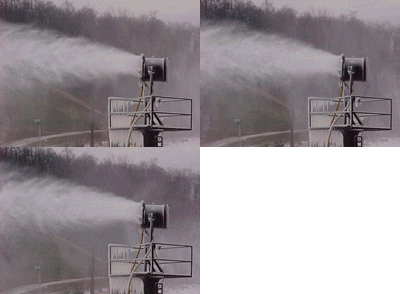
Blowing snow. A fan gun converts water to snow on the slopes of Ski Roundtop. Image courtesy of Ski Roundtop.
|
In Hagerstown, Maryland, for instance, the average high temperature in January is 37.8 degrees Fahrenheit and for February, 40.9, and March, 50.7. In short, nearby Whitetail Resort gets thawing temperatures nearly every day of the regular season. So how do “The Tail” and other close-by resorts keep 100 percent of their terrain open from mid-January through mid-March? The answer is the power of SNOWMAKING!
Snowshoe, in West Virginia, can cover 100 percent of its 57 slopes with snow made with water pumped from its 16-hectare lake and compressed air generated in its computer-operated compressor house.
“When we’re making snow, we’re making it with three shifts working around the clock,” says Joe Cummins, snowmaking supervisor at Snowshoe Mountain. “When the weather’s right, we make as much snow as we can, as fast as we can. We never know when we’ll have a warm spell.”
His boss, Ed Galford, the Vice President of Operations, added, “Without snowmaking, Snowshoe doesn’t exist. Every ski resort in the Mid-Atlantic can say that. You get a rainstorm at Christmas and you’re bankrupt no matter where you’re located.”
Here’s an important fundamental: snow made by ski resorts is REAL snow. There’s nothing artificial about it. Snow crystals - however they are produced - are simply minute crystals of frozen water.
In Nature, evaporation of water from the ground, lakes, rivers and the oceans creates moisture in the atmosphere. Under the proper conditions, this moisture condenses - and when the weight of the moisture exceeds the capacity of the air to keep it aloft, it falls to the ground. If the air above the ground is cold enough, water falls as snow. Often the crystals pick up more moisture as they fall, resulting in the myriad shapes for which snow crystals are famous.
|
|
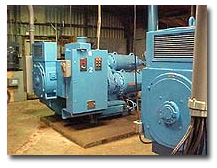
Compressing air. Compressors at Ski Roundtop generate chilled, compressed air, which is then pumped through pipes along the slopes. Image courtesy of Ski Roundtop.
|
For Mid-Atlantic snowmakers, two factors have a profound influence on the process: temperature and relative humidity. People often look at their Eddie Bauer thermometers on their ski jackets and say, “Hey, it’s below 32 degrees, why aren’t the snow guns cranking?” The answer is humidity. In general, the more humid the air, the lower the temperatures have to be to be for snowmaking.
|
|
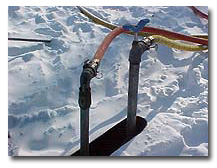
Miles of pipes. Miles of pipes carry water and compressed air to guns along the slopes. Image courtesy of Ski Roundtop.
|
Most resorts can make snow any time the wet bulb temperature is at 28 degrees Fahrenheit or colder. Snow made at the upper end of the range requires more compressed air than snow made at lower temperatures. As you’ll see, this is more expensive. And in fact, there are temperatures below which our resorts generally won’t make snow. Any temperature colder than -20 degrees Fahrenheit can create problems for snowmaking - primarily in the form of cracking water pipes.
For a guide to temperature and snowmaking, see the following chart:
http://www.backyardblizzard.com/guide.htm
Another complaint often heard in the lift lines is, “Why are they making such wet, heavy snow. It’s slowing me down! I prefer the dry stuff.”
Dry snow is certainly the most fun to ski. But it isn’t always optimal, depending on what a ski area is trying to do. At resorts with sophisticated snowmaking control systems, crews will sometimes make wet snow deliberately. This is generally done when a trail is first made for the season, or when a thaw cycle has greatly reduced base depth. Wetter snow frequently has greater volume per gallon of water than does dry snow, which means the trail can be covered more quickly.
Some ski resorts make wet snow specifically due to the durability factor - for example, if a trail receives a high volume of skier traffic, snow may be made with greater density to ensure that it will stand up to skier traffic. Some resorts, in order to save money, will aim to make comparatively deep, wet, heavy snow once or twice a season on any given trail, then call it quits for snowmaking. All further snow conditioning relies on Nature and the Snowcats.
There are two basic weapons in the snowmaker’s arsenal: guns which work with compressed air and airless guns.
Compressed air guns utilize compressed air and water to produce snow. When compressed air is released and goes back to its original pressure, a great deal of mechanical energy is released. In a snowmaking system, that energy effectively propels the water droplets away from the gun and out over the trail, where it can crystallize and fall to the ground as snow. At the same time, a great deal of heat is absorbed, as nature tries to balance the heat between the expanding gas and whatever’s around it. Essentially, heat moves from the surrounding area into the expanding gas. This means the surrounding area now has less heat in it - in other words, it cools off.
Because Air/water guns can generate more expansion cooling than airless guns, they work better in warmer temperatures and are therefore favored by most of the resorts in the Mid-Atlantic. However, they require a lot of infrastructure to support them: two sets of pipes running up the mountain (one for air and one for water), and a pumping and compressing facility at the base of the mountain. For a good example of a large-scale compressed air system, take a look at the snowmaking towers lining many of the slopes at Seven Springs.
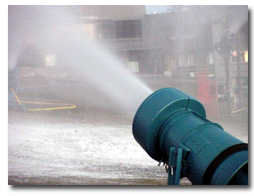
The other major type of snow making gun is the airless gun. These contraptions look like oil barrels with fans at the back of them. Airless guns spray water out of small nozzles similar to the spray valves on garden hoses. The nozzles ring a large, electrically powered fan in the center of the “barrel.” The fan disrupts the jets of water into small droplets, and propels them into the air.
|
|
Physics at work. An airless gun blasts snow onto the slopes of Snowshoe. Image courtesy of Snowshoe Mountain Resort.
|
Even though airless guns don’t work as well in warmer temperatures than air guns, I suspect many of the local areas are upgrading with airless systems so as to conform to the National Ski Areas Association’s Sustainable Slopes Charter. Airless systems use less energy and don’t require as many pipes to operate. Given the rising costs of electricity and natural gas, energy conservation also makes good sense from an economic point of view as well.
In addition to airless guns, operators now have another powerful tool for managing energy costs - the computer. The operator can track the amount of energy being used, ensuring the resort’s electrical demand doesn’t exceed limits set by the power company. (Snowmaking can require substantial amounts of electricity - you wouldn’t want to get a resort’s electricity bill.)
Secondly, readouts give control room operators a running tally on what apparatus is running and the system status. With the click of a mouse, the operator can tell exactly how much water is going to the hill (and what its pressure is). Operators can also determine how much compressed air is available. Because the demands on air and water delivery are in constant flux, the operator must be able to deliver more - or less - air and water to the hill.
Computers also collect weather data from sensors on the mountain, and make calculations to determine the optimal settings at each gun. In this manner, snowmakers can make very consistent snow with optimal energy efficiency. In fact, the computer control systems actually allow snowmakers to make snow in a range of production grades - from Type 1 (super light, super dry) to Type 10 (which is very heavy and wet). Resort managers may elect to make different types of snow depending on trail conditions.
New technology, overall, is helping resorts make more snow, cheaper, and with less impact on the environment. However, criticism of snowmaking by environmentalists continues. The main argument against snowmaking is that it depletes streams and ponds, raises the acidity of the water, and kills fish and other organisms crucial to the eco-system. Keystone, for example, diverts up to 6 cubic feet per second - half the Snake River’s total flow at times. The noise from snowmaking also disrupts hibernation patterns of bear and other animals. Finally, environmentalists are raising concerns about new methods of snowmaking which insert Snomax, an inert bacterial additive, to enhance crystal formation at warmer temperatures.
Many ski resort owners have countered these concerns by signing the National Ski Areas Association’s Sustainable Slope’s Charter (currently signed by 60 percent of U.S. resorts, including Seven Springs, Whitetail, Timberline, Snowshoe, Liberty Mountain, Ski Roundtop, and Massanutten). The charter calls for:
For a complete version of the charter, see: http://www.nsaa.org/nsaa2002/environ_charter/charter2k.pdf. (PDF format.)
The most notable changes being sparked by Sustainable Slopes are narrower trails, requiring less snowmaking and the destruction of fewer trees . Other programs include more promotion of recycling, yearly wildlife studies (often sponsored in conjunction with the local universities), trail closings to protect wildlife, and encouraging guests to re-use towels, generate less laundry, share rides to the slopes, and take “Navy” showers (5 minutes or less).
Vail Resorts has even gone so far as purchasing the maximum amount of wind-powered electricity available in Colorado to help power its lifts, eliminating the need to burn 570,000 pounds of coal. Locally, Whitetail has a system of small aqueducts which capture run-off from slopes and store it in local ponds for re-use in snowmaking - in effect “recycling the snow.”
So where does all this leave Mid-Atlantic resorts? Well, unlike in the West, most resorts here have no shortage of water here so in theory, snowmaking should not produce that much damage to the local environment. For example, Maryland’s Wisp Resort can draw from the 16-mile long Deep Creek Lake -; offering an endless supply of water. The amount of water used by most area resorts over the course of an entire season usually doesn’t affect the watershed much.
That said, some resorts with big expansion plans need to be more environmentally aware. The Western Territory of Snowshoe does a good job of following the Sustainable Slopes policy with a limited number of narrow, tree-lined trails, and Snowshoe continues to expand its snowmaking reservoirs to capture and recycle water.
Seven Springs’ Big Boulder trail, on the other hand, is more questionable. To create an intermediate trail on the North Face, Seven Springs cut a huge swath out of one the last forested areas on that side of the mountain and then disrupted the local environment even more by moving a lot of earth around to make the trail less steep. Additionally, Seven Springs plans to develop more of the North Face/Tahoe area by building additional houses and condos, a new lodge, a people mover that connects the Wagner Lodge with the new Tahoe Lodge, more lifts, and more access roads. In defense of the Springs, it did sign the Sustainable Slopes Charter. It will take some effort to ensure that aggressive expansion plans obey the spirit as well as the letter of the charter.
So what can we do? Encourage resorts to sign the Sustainable Trails charter, be conscious of our own water use when staying near slopes, don’t pollute, and observe trail closings and border markings at ski areas. Resorts can have good reason for closing trails - to protect skiers and boarders from hazards, or even to reduce stress on the local wildlife.
Skiing would be dismal in the Mid-Atlantic without snowmaking. Resorts as well as skiers just need to be aware of its environmental impact and continue to strive to reduce that impact at every turn.
Note: This article was originally published on DCSki on November 11, 2001.